
FracTracker Alliance is Providing Data that Powers Successful Cases
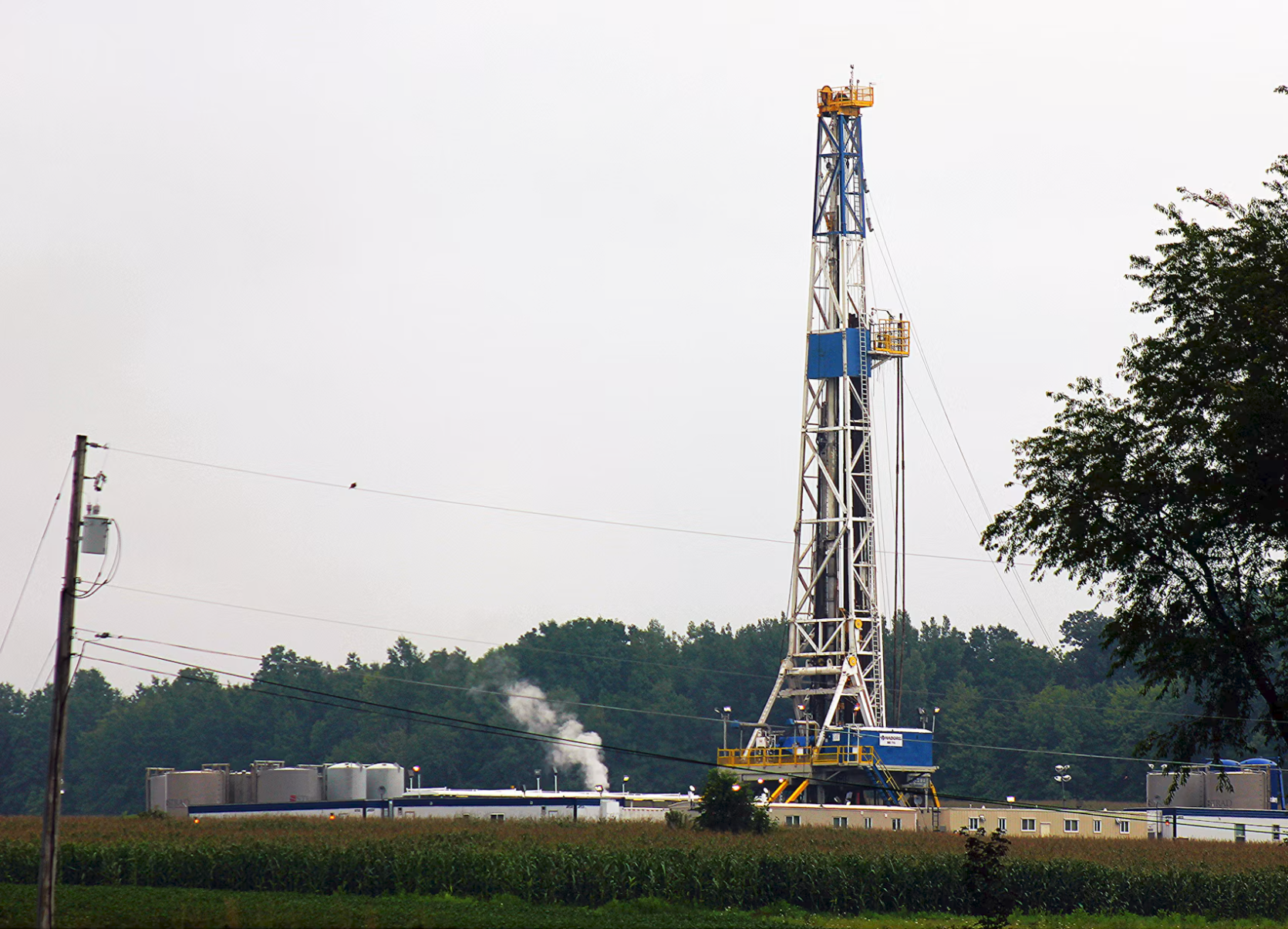
A natural gas drilling rig on the Marcellus Shale formation in Pulaski, Pennsylvania. Wells like this one are drilled and then fracked to extract gas. Photo: Brad Weaver / Unsplash
October 1, 2026
For every case youth bring to protect their rights, there are countless behind-the-scenes partners that collaborate with Our Children’s Trust to ensure youth are supported by the most current and best science.
Lawyers draft briefs with strong legal strategy. Leading experts write reports using the best available science. Community members amplify the case and show up for the youth.
Perhaps some of the most unsung heroes are the organizations compiling data and doing deep-dive research to ensure public access to essential information, like our friends at FracTracker.
FracTracker Alliance
FracTracker Alliance was born out of a need for information on the public health and environmental impacts of the fracking industry. In 2010, the fracking industry was rapidly expanding across southwestern Pennsylvania. There was a major information gap, as industry withheld key information and regulators failed to provide the public with a clear picture of fracking’s health and environmental risks. In response, a group of students and faculty at the University of Pittsburgh stepped in to fill the gap.
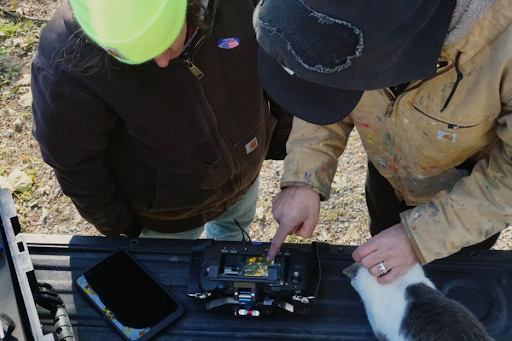
Kyle Ferrar of FracTracker Alliance plans a drone flight path to document shale gas infrastructure in Robinson and Smith Townships, Washington County, Pennsylvania. Photo courtesy of Chloe Mankin, FracTracker Alliance.
Now, FracTracker collects scattered and hard-to-access data from across the country, using it to map, analyze, and communicate the risks of oil, gas, and petrochemical development. The resulting maps, analyses and other resources transform data into a useful and accessible form for communities and advocates to use in the advocacy work they are leading. Their mission is to advance just energy alternatives that protect public health, natural resources, and the climate.
Using Data to Win Landmark Cases
In the historic youth-led constitutional rights case, Held v. Montana, FracTracker’s data proved critical in Dr. Mark Jacobson’s expert report. Dr. Jacobson is one of the world’s leading energy experts who is a professor of Civil and Environmental Engineering at Stanford University, and Director of Stanford’s Atmosphere/Energy Program in the Department of Civil and Environmental Engineering. Dr. Jacobson researches the impacts of human emissions of greenhouse gases and particles from fossil fuels on air pollution, human health, weather, and climate. He has developed roadmaps for transitioning all energy sectors in 50 U.S. states, and 150 countries to 100% clean, renewable energy by 2050.
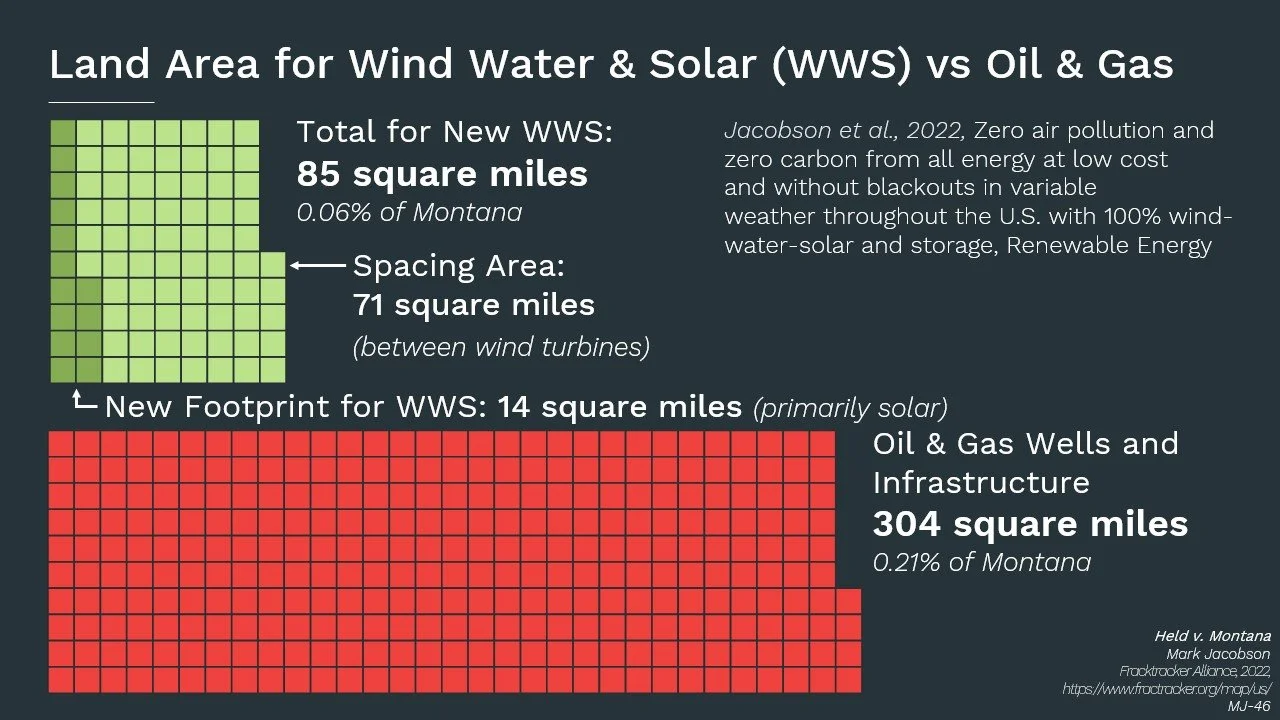
Using data from FracTracker, Dr. Jacobson was able to calculate (displayed in the above graphic) the total land area used by oil and gas wells and infrastructure in Montana: an astounding 304 square miles. Comparatively, the amount of land that wind, water, and solar energy would take up to produce all the energy that Montana needs was only 85 square miles.
Held v. Montana was the first constitutional climate case to ever go to trial in the United States. Many factors contributed to a win: the plaintiffs’ bravery in telling their stories, countless hours of legal briefing and preparation, expert reports and testimony from world-renowned scientists and policy specialists, and, of course, data and science to back it all up.
When youth, lawyers, and experts get the chance to present the facts in a courtroom, the truth becomes undeniable, and the rights of youth are concreted into law. This win in Montana was made possible by sound, reliable data and science. FracTracker makes this kind of data readily available to the public in a unique way.
The Importance of Data
During a time when access to data in the United States is under attack, FracTracker believes it’s even more important than ever to provide open access to resources. Compiling information from many different sources, FracTracker publishes easy-to-access data in the form of interactive maps, analyses, and visual tools.
FracTracker does all of its work through the lens of environmental justice. “A tenet of environmental justice is people having a say in what is being done in the environment around them,” says Shannon Smith, Executive Director of FracTracker. “They cannot have a say if they have no access to information on what those projects are or what risks they pose.”
Whether it’s providing data on how much water is being sucked up by the fracking industry and depleting the life-giving springs of the Navajo Nation in the Southwest, or information on the hazardous chemicals being used in fracking operations that poison communities in Pennsylvania, FracTracker is dedicated to being a reliable source people can turn to.
Another Historic Trial
This year, Canada will hold their first trial for a youth-led federal climate case, La Rose v. His Majesty the King. Fifteen youth plaintiffs filed La Rose and are arguing that the federal government has violated their constitutional rights to life, liberty, and security of the person under Section 7 of the Canadian Charter of Rights and Freedoms by continuing a trajectory of greenhouse gas emissions that causes them serious and significant harm.
Since FracTracker’s data proved to be an asset in Held v. Montana, it could support the arguments being made at the La Rose trial in October.
FracTracker has found that the active and abandoned wells in Alberta and British Columbia alone—only 2 of the 10 provinces and 3 territories that make up Canada—took up more land area than water, wind, and solar energy would take up to meet all of Canada’s energy needs. This data illustrates one example of how Canada is continuing to prioritize fossil fuels over the lives and health of its youngest citizens.
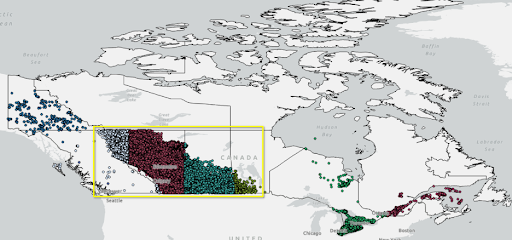
The map shows identified abandoned and active wells in Canada. The highlighted area marks the heaviest concentration, stretching across British Columbia, Alberta, Saskatchewan, and Manitoba.
The Emergence of Data Centers
Now, the Artificial Intelligence, or AI, boom is driving a wave of data center construction across the country. These massive industrial facilities can consume vast quantities of power, and are often paired with the expansion of gas-fired power plants and other fossil fuel infrastructure. More than 90% of the gas in the US is produced by non-conventional means like fracking, which co-opts and pollutes local water resources on top of the water demands for cooling servers made by the data centers themselves. As data centers raise serious health, economic, environmental and energy concerns, they are facing widespread community opposition, especially when powered by fossil fuels or placed in regions with limited available water resources like in the arid regions of the western U.S. Our Children’s Trust recently filed an appeal, McIntosh v. Pennsylvania Department of Environmental Protection (DEP), on behalf of 15 Pennsylvanian youth challenging the Pennsylvania DEP’s issuance of a permit for the Homer City Redevelopment Project.
The permit authorizes the construction of one of the nation’s largest gas-fired power plants, intended to power a 3,200-acre data center campus. The plant would emit approximately 17.5 million tons of greenhouse gases in carbon dioxide equivalents annually, worsening the climate crisis and threatening the rights, health, safety, and lives of these young people, some of whom live in the airshed of the proposed data center.
FracTracker’s tool, Data Centers Tracker Dashboard, is the first open-access, facility-level dataset and interactive mapping tool that documents the rapid buildout of data centers and AI infrastructure across the United States. It brings together information on where new facilities are being proposed and built, how much energy and water they may require, how they are powered, and how communities are responding.
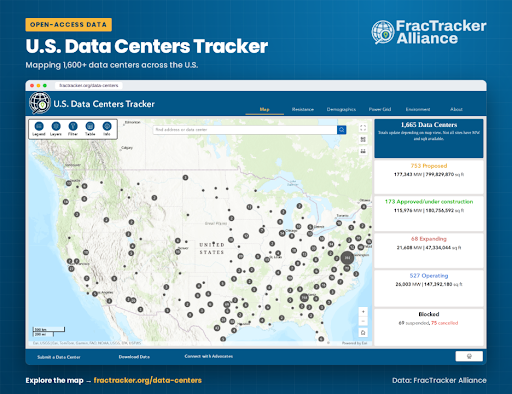
FracTracker’s Data Centers Tracker
This transparency is essential for accountability and advocacy. Data center expansion is outpacing both regulation and public awareness, and has often bypassed meaningful public input. Without transparent, facility-level information, communities cannot effectively advocate for local protections and researchers and decision-makers cannot fully assess the potential impacts of existing and proposed data centers.
Access to Information
Access to information is not just about winning court cases: it’s about people having the power to shape what is happening in their own communities. Knowing what is happening to the land, water, air, and essential public trust resources around your home is a right that shouldn’t be denied.
FracTracker has stepped in where government regulators and corporations have often failed. They’ve done the difficult work of gathering scattered information, analyzing it, and turning it into tools communities can use to understand and challenge what is happening around them. We are grateful for their dedication to public access to information and how they have helped us secure youth's future, one case at a time.
To learn more and explore the maps and data FracTracker has about your community, visit the FracTracker website or download the app! If you need custom maps, data, or other support for your community or campaign, you can also request FracTracker’s help or sign up for the monthly newsletter to stay up to date on new maps, analyses, and resources.