

Hawai’i Makes Its Future So
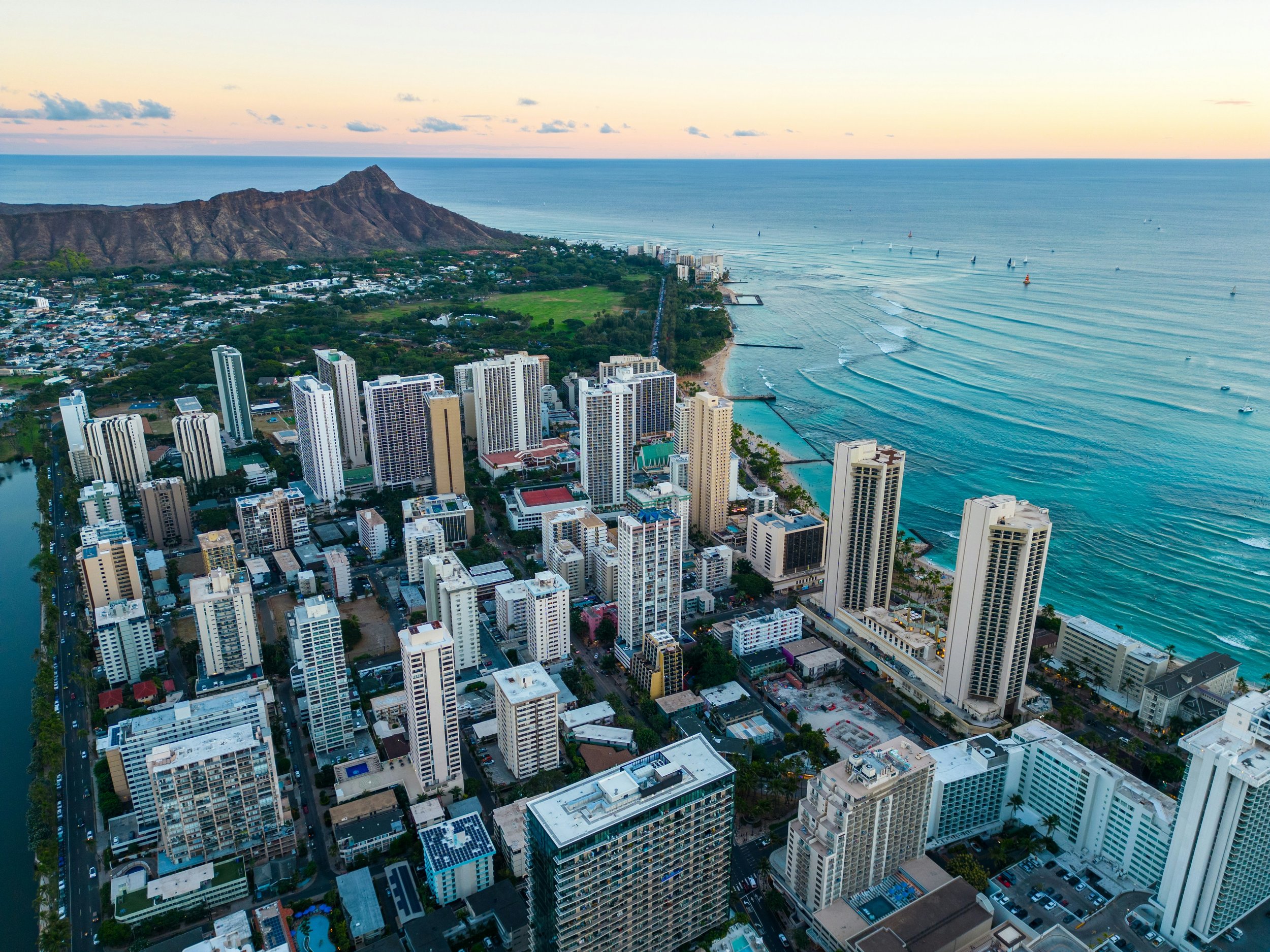
Honolulu, Hawai‘i. Photo by Spencer Sembrat.
June 17, 2026
I was in grad school doing my usual Saturday used-bookstore perusal when I stumbled upon Aldous Huxley’s Brave New World Revisited. In this work of non-fiction, Huxley compared the fictional future he put forth in Brave New World and the fictional future envisioned by George Orwell in 1984 to the real world of the late 1950s. These two different views of the future stemmed from a similar starting point in the tumultuous first half of the 20th century.
This idea of vastly different futures from a similar starting point is encapsulated in the different emission pathways that project future climate change: the Shared Socioeconomic Pathways, or SSPs. These different future levels of greenhouse gas emissions and atmospheric concentrations are not abstract. They are rather the outcomes of various views of what future societies will be like and how society will power itself (something akin to science fiction but with more numbers and equations). High greenhouse gas emissions from fossil fuels require a world with high consumption and low regulations or high protectionism and high inequality. Conversely, reducing greenhouse gas emissions requires international cooperation, increased equality, and conscientious consumption powered by clean and renewable energy.
Thirty years ago, when such future socioeconomic emission scenarios were first being developed, there was much hand-wringing by wise people about the price of low-emission futures. But now, with the cost of solar energy and battery storage plummeting to below the cost of gas and coal power plants and with many electric vehicle (EV) models costing less than their gasoline equivalent (at least in every country save the United States), the economic tables have turned. It is no longer a question of whether we can afford a given future. The question is now: ‘What future do we want?’
The future, e.g., SSP, that becomes reality is determined by the choices we collectively make today.
On June 1, 2022, the thirteen youth plaintiffs in Navahine v. Hawai’i Department of Transportation (HDOT) decided on the future they wanted. They looked at the state of Hawai’i and, particularly its transportation system, and found it lacking. HDOT had made no plans for the future, save for keeping the status quo.
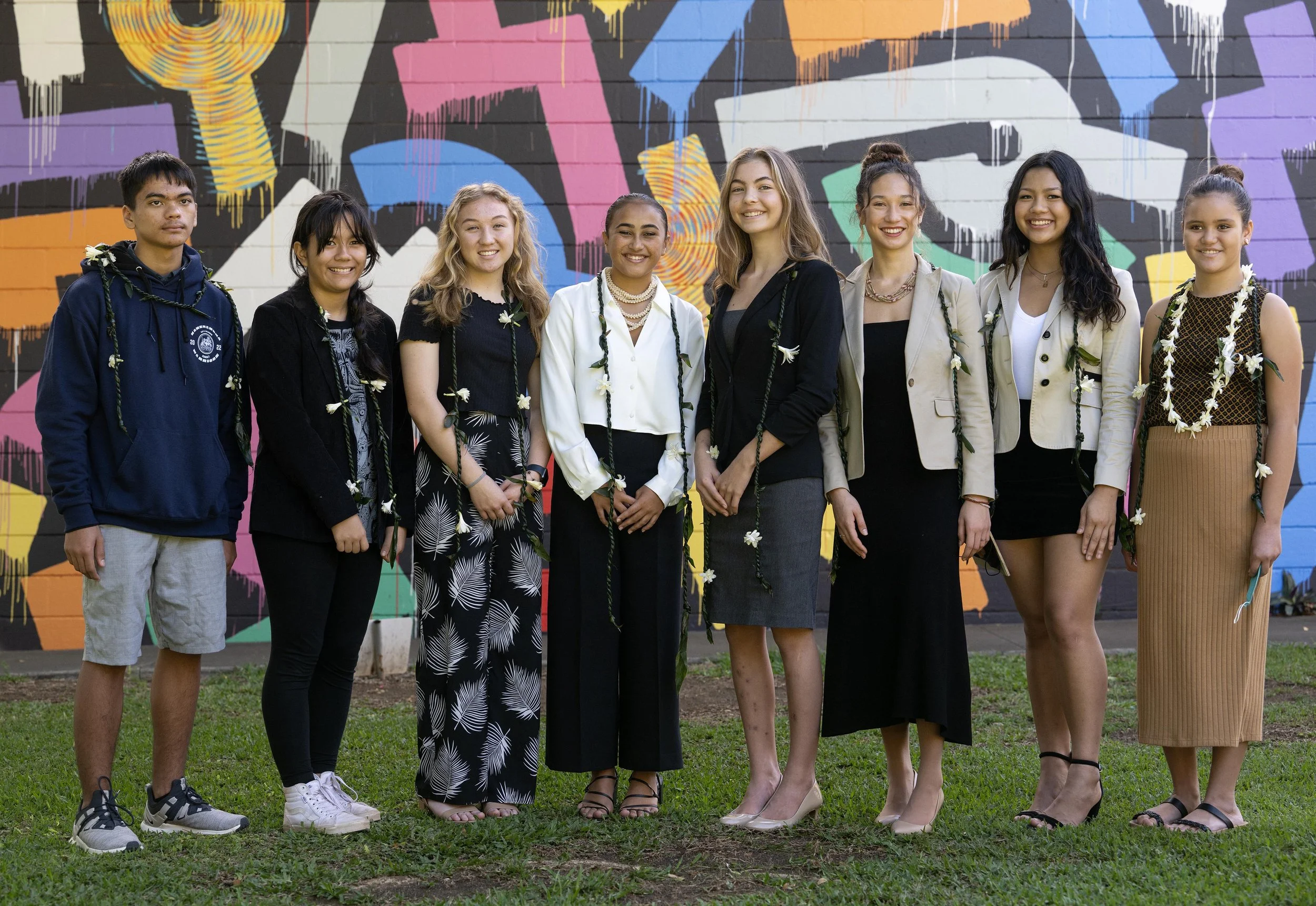
Eight of the thirteen youth plaintiffs in Navahine v. HDOT. Photo by Robin Loznak.
What was that status quo? HDOT had the same answer over and over again to rising traffic congestion: more road lanes. HDOT pursued this adding-lanes approach even though research had shown that more lanes only encourage folks to take that road, negating the expansion’s intention. How about encouraging the use of non-fossil fuel-dependent means of getting around? While there were plans for pedestrian zones, bike lanes that connect different parts of cities, or pedestrian/bike overpasses on the books for years, they were being ignored. And, when they redesigned the airport, HDOT approved plans that removed charging station for rental EVs, further limiting the ability of EVs to take hold.
It was not surprising that the government of Hawai’i projected that the state would emit the same quantity of greenhouse gases from transportation in 2045 as it did in 2022. Now that is keeping the status quo. And that is why these thirteen youth sued HDOT.
After some kerfuffling, the government of Hawai’i looked at the future these youth wanted, and their expert witnesses said was possible, and went, in my own words, “that looks pretty darn good! Why aren’t we doing that!” On June 20, 2024, Hawaii Governor Josh Green and HDOT Director Edwin Sniffen announced the landmark settlement that set Hawai’i on the path towards the future these youth said they wanted. The choice was made.
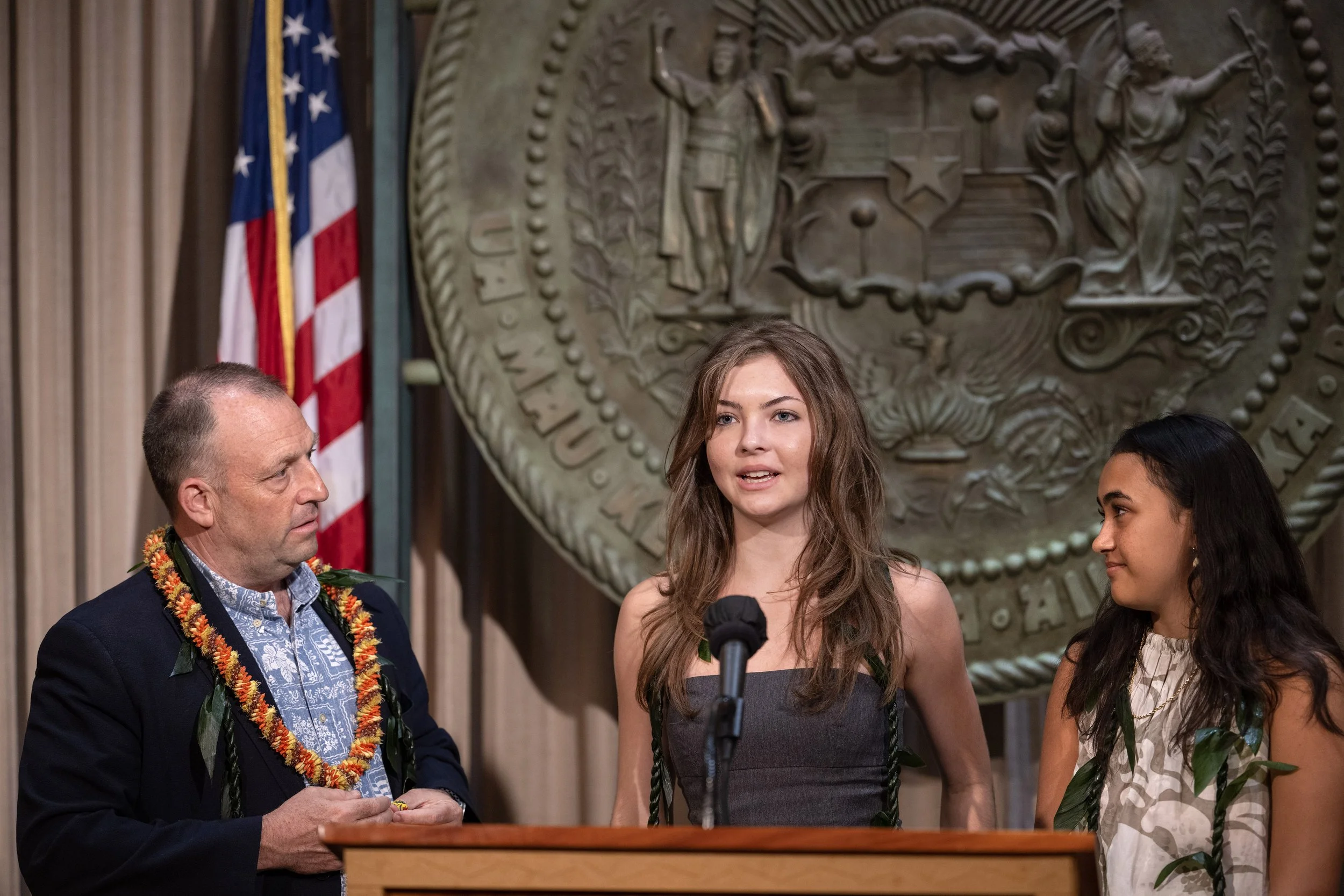
Hawai‘i Governor Josh Green (left) and youth plaintiffs Mesina (middle) and Navahine (right) at a press conference announcing the settlement agreement on June 20, 2024. Photo by Robin Loznak.
And what does this choice include? Well, HDOT is to work with a youth council and craft a plan to eliminate greenhouse gas emissions from its transportation sector by 2045. By 2030, HDOT and the youth council will have transportation infrastructure developments that don’t emit greenhouse gases, such as clean public transit and expanded public electric vehicle charging, as well as making the state safer for pedestrians and bikers. Notably, HDOT will also work to reduce the number of individual vehicle miles traveled, addressing the congestion issues that have long plagued the state. These changes will mean Hawai’i will stop emitting a mass of greenhouse gases every year from its transportation alone that is around the entire energy emissions of the state of Rhode Island and nearly double that of Vermont.
There is also another major impact that won’t be as obvious or measurable in the Navahine v. HDOT settlement: The choice of a government to listen to their youth with a vision, find common ground, and start working together for a better tomorrow. The future that the Navahine youth want is not some radical path to a dystopia. It’s things like bike paths, easy-to-cross streets, places to shop and walk without worrying about being hit by a car, reliable buses that don’t pollute, clean air, less traffic, and a more affordable way of life. You know, things people like! And this is precisely the type of cooperation that should be scaled up as envisioned in the rosiest of SSPs. It is a model for hope.
This future that these Navahine plaintiffs have chosen reminds me of another fictional future of optimism and enlightened humanity that Gene Roddenbery envisaged in Star Trek. So, I will close with the words of Captain Jean-Luc Picard of the Starship Enterprise: “make it so.”