

The Great White North Is Burning!
October 27, 2025

The Canadian Rockies. Photo by Louis Paulin.
Canada holds a special place in my heart. I began visiting the Great White North as a baby on family vacations. We would boat across Lake of the Woods from Minnesota’s Northwest Angle into Manitoba waters, where the better fishing lay. I turned these youthful trips to Canadian lakes and rivers into my Ph.D. research, documenting the final retreat and disappearance of the world’s largest ice sheet, the Laurentide. This research led me to drive across northern Manitoba and Quebec. As a professor, I expanded that work to Labrador, Ontario, Alberta, British Columbia, and the Northwest Territories. I’ve also kicked around Nova Scotia, visiting a Canadian marine core lab there to sample sediments that would record Laurentide meltwater discharge through the St. Lawrence Seaway to the North Atlantic and how it impacted ocean circulation.
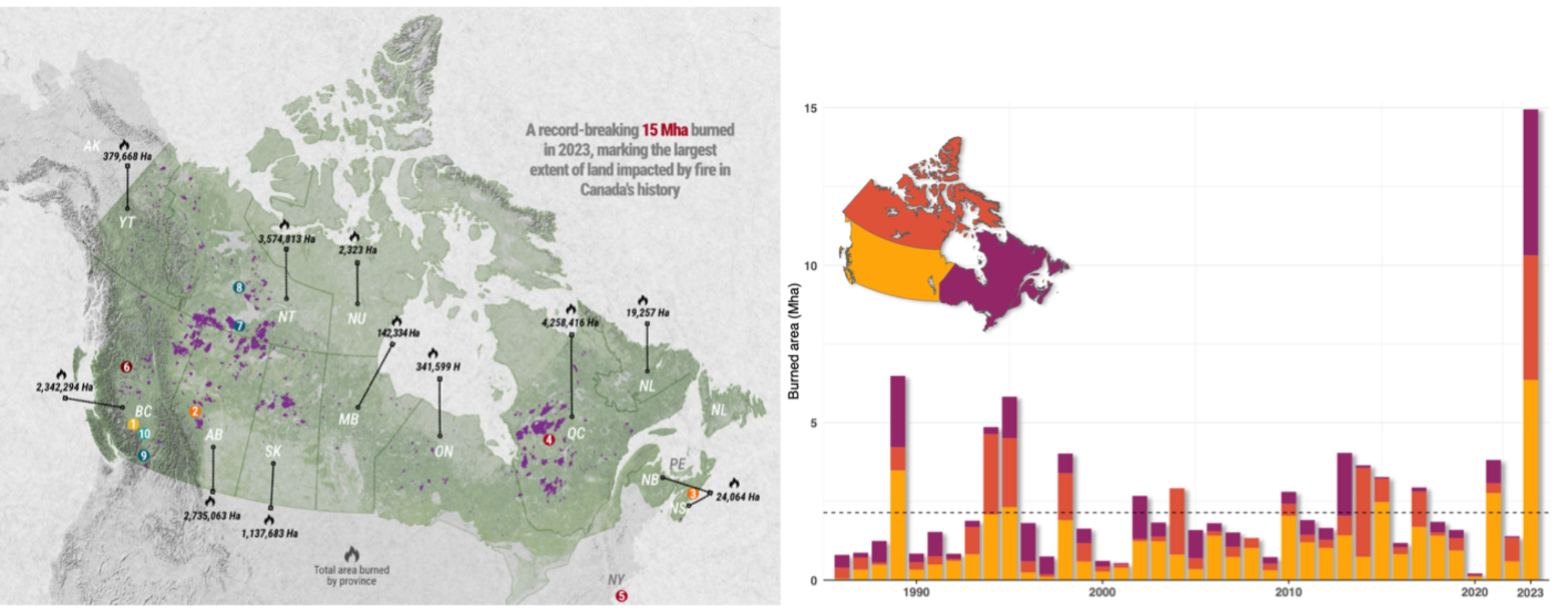
Figure 1: Canada’s 2023 fire locations are shown on the left in purple. The first two photos below (Photos 1-4) are from near the “4” in Quebec, while the second two photos are from near the dot in Labrador. On the right is the annual area burned, where the color reflects the amount of the three regions (inset) burned. Source is Jain et al. (2024).
What I’m trying to convey is that I know and deeply love Canada, with a relationship going back nearly half a century. And that is why I was floored when the record setting 2023 fires burned through Quebec and Labrador (Figure 1). When I first visited the Quebec-Labrador high plateau in 2004, we marveled at the cool forests, wet bogs and rolling uplands, with snow persisting into July (Photos 1-4). This region looked like it was primed to grow a new ice sheet, if it was only a little bit cooler (Photos 1-2).

Photos 1-4: The top photos (1, 2) are from the interior high plateau of Quebec near the border with Labrador in 2004. The lower photos are from central Labrador in 2010 (3, 4).
Five years later, we showed that this region gets precipitation that helps build and sustain an ice sheet at a relatively low latitude. But that was in the before-fossil-fuel times. Now, in the land where a timber wolf once stared me down (Photos 4), the 2023 fires raged in response to the warming caused by the burning of fossil fuels.
The summer of 2023 was the warmest and driest summer since at least 1980, with a 2023 temperature that was 2.2 Celsius or 4.0 Fahrenheit warmer than its 1991-2020 average. In response, about 15 million hectares (5,800 square miles) of Canada burned, which was more than double the previous record (Figure 1). For context, 15 million hectares are roughly the combined areas of Connecticut and Rhode Island. These 2023 fires emitted more carbon dioxide to the atmosphere than the fossil carbon dioxide emissions from every individual country in the world save China, the United States, and India.
More than 200 communities were evacuated, and millions were exposed to hazardous air. Poisonous smoke and particulates from these fires spread down into the lower 48, producing the highest regional ozone levels ever recorded in the northern United States. From the Midwest to the Atlantic coast, skies were orange with this pollution.
Further west, while working on the eastern edge of the Canadian Rockies in Alberta and British Columbia, I had the opportunity to study some of Canada’s modern glaciers. We were there to determine when the Laurentide ice sheet separated from Canada’s other ice sheet, the Cordilleran, and how that contributed to rapid sea level rise. I noted how these many-orders-of-magnitude-smaller flowing ice masses themselves were in retreat (Photos 5-7).
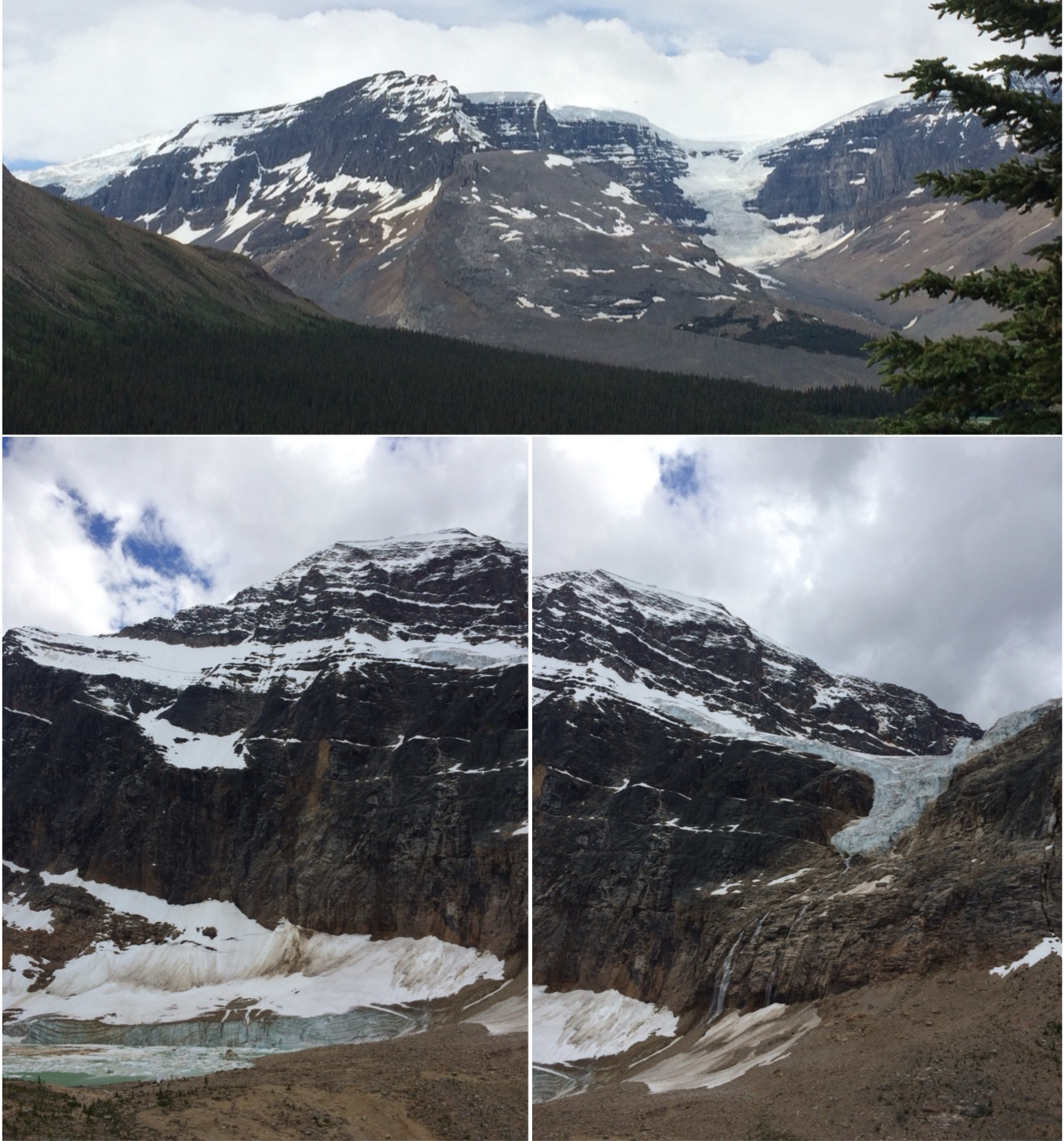
Photos 5-7: The top photo shows an outlet glacier from the Columbia Icefield in 2016 that is becoming cut off from the icefield as the climate warms (5). Bottom photos show Angel Glacier in 2016 (7), which hangs above a lake (6). In 2012, an ice mass (called Ghost Glacier) to the looker’s left of the glacier (6) fell off the rock wall and into the lake, causing a glacier outburst to flood down the valley.
Canada has the most climate-sensitive glaciers in the world. In the first 23 years of this millennium, western Canada’s glaciers lost about 23% of their mass. Since 2020, they lost about 12% of their mass. This glacier mass loss is entirely due to a hotter climate caused by human carbon dioxide emissions, which are almost entirely from the burning of fossil fuels. In fact, so much fossil carbon dioxide has been emitted that at our current global warming level, about 75% of western Canada’s glacier mass will melt away!
This glacier retreat in western Canada is increasing glacier hazards, although they may not receive as much media attention as glaciers recently falling down in the European Alps. The lower 6 and 7 pictures in Photos 5-7 show Angel Glacier in Jasper National Park. This glacier’s terminus hangs above a lake, and when chunks of ice break off into the lake, a giant flood wave will surge down the valley. This actually occurred in 2012 when a large swath of ice called Ghost Glacier, to the left of the glacier terminus in photos, fell into the lake. Luckily, no one drowned in the flood. But as the climate warms and glaciers melt, risk of these types of floods increase, and next time folks could be in the way.
Another factor that is driving more fires and the loss of glaciers is heatwaves. In June 2021, Canada (and I, along with the rest of the Pacific Northwest) experienced one of the most, if not the most, extreme heatwaves ever recorded on the planet. It was scorching hot here in Oregon, but the worst part of the heat wave struck British Columbia, where temperatures reached more than 18 Celsius (32 Fahrenheit) above the 1981-2020 average and a new record temperature of 49.6 Celsius (121.3 Fahrenheit) was set. Hundreds of people died and crops were ruined. Glacier and snow melt caused floods, while the drier landscape was primed for wildfires.
This unparalleled Pacific Northwest heatwave would never have occurred if not for human burning of fossil fuels, because it occurred in a background climate that was unprecedented in at least a millennium (Graph 1). The 11-year average summer temperature surrounding the heatwave was about 2.2 Celsius (4.0 Fahrenheit) warmer than it was in the second half of the 19th century and 1.2 Celsius (2.2 Fahrenheit) warmer than it had ever been in at least the last 1,100 years.
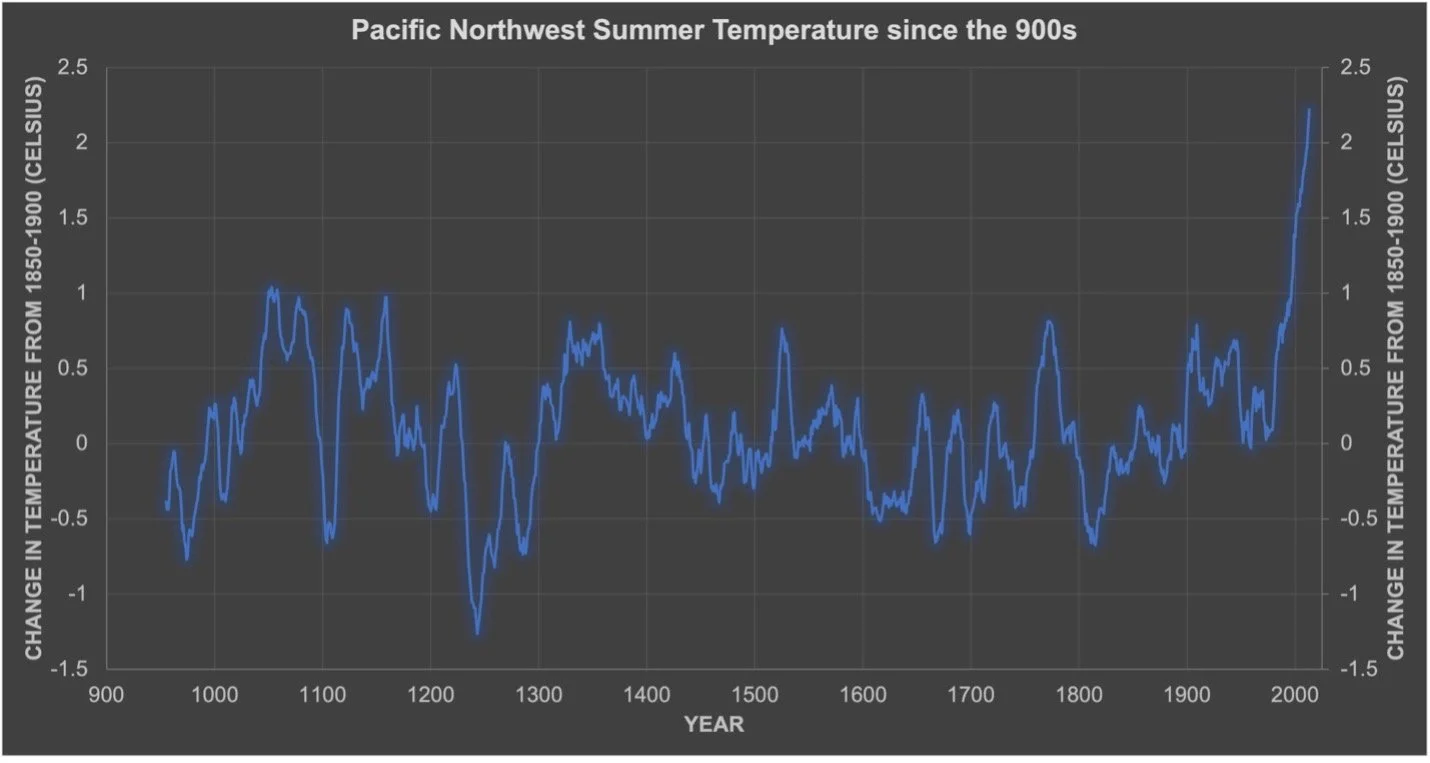
Graph 1: Change in 11-year average summer temperature for Oregon, Washington and southern British Columbia back to 950 Common Era. Data from Heeter et al. (2023).
What is the Canadian government planning to do? Well, Canada’s current policies would result in global warming of up to 3 Celsius (5.4 Fahrenheit) by 2100. Canada also has a Net-Zero Act, which means the country intends to have summed greenhouse gas emissions and carbon dioxide removals equal to zero by 2050. The Net-Zero Act, if implemented perfectly, would result in global warming of up to 2 Celsius (3.6 Fahrenheit).
Well, before even talking about any issues in implementing the Net-Zero Act, let’s put these Canadian plans in Great White North terms. If current policies are pursued, all of western Canada’s glaciers will melt away. So much for being “white,” let alone “great.” In the case of the Net-Zero Act anticipated warming level, only about 10% of western Canada’s glacier mass will remain. We will have to refer to Canada as “The Country Formerly Known as the Great White North,” with apologies to Prince.
Okay, that’s how bad it is when you assume the Net-Zero Act will be implemented as promised… But what’s behind their green mask? Well, it is far worse. Hidden in Canada’s Net-Zero Act is a plan to increase Canada’s extraction of fossil fuels going forward to 2030, with no plans to end the extraction of fuels!
In Graph 2, I calculate the carbon dioxide emissions from Canada’s planned fossil fuel extraction. Canada wants to extract fossil fuels, which would result in 29.4 billion tons of carbon dioxide emitted to the atmosphere between 2025 and 2050. That’s an average annual emission of 1.18 billion tons of carbon dioxide, which is about the annual fossil carbon dioxide emissions of all South American countries combined.
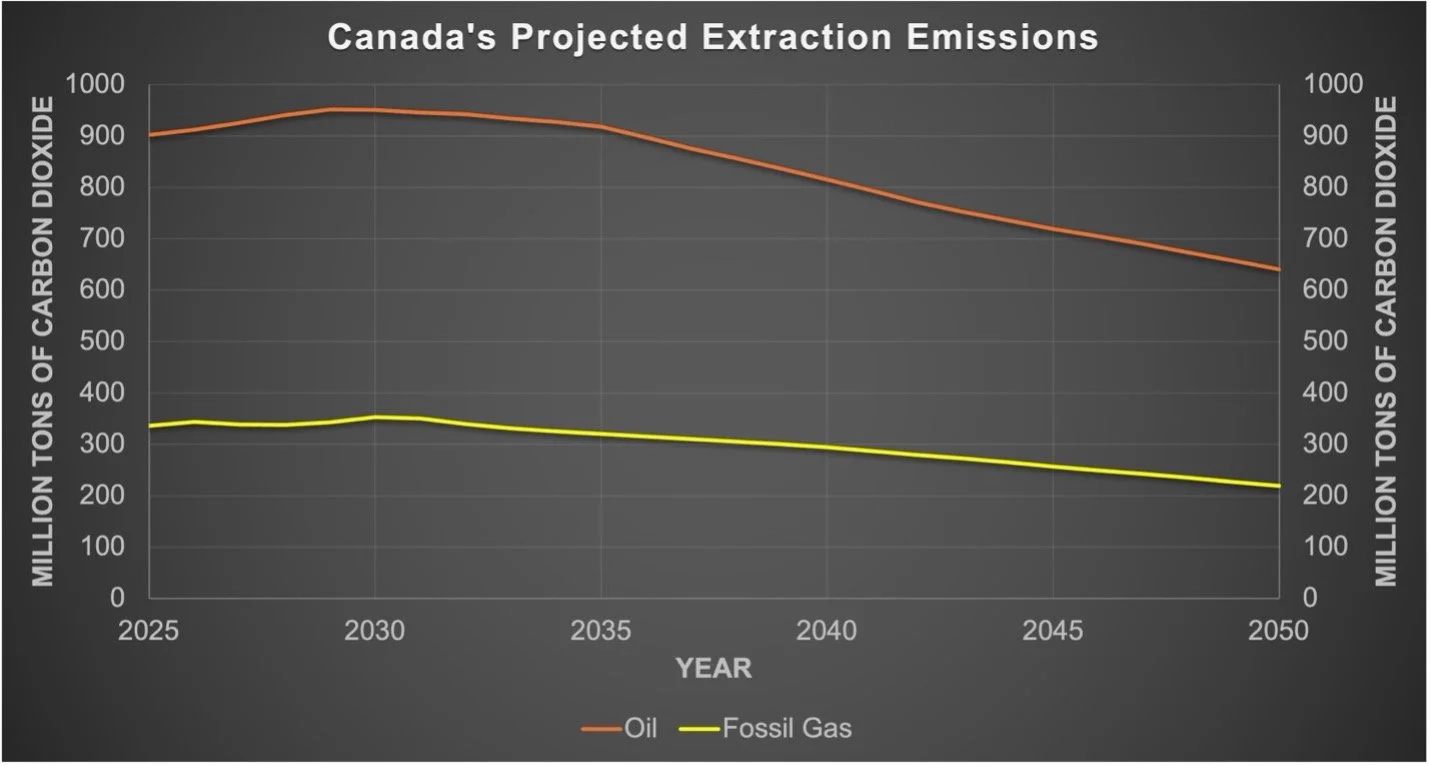
Graph 2: The carbon dioxide emissions from full combustion of Canada’s planned extraction of oil and fossil gas in their Net-Zero Act from 2025 through 2050. Data from Canada’s Energy Future converted to carbon dioxide emissions following U.S. Environmental Protection Agency.
To put this in context, the International Energy Agency has found that all fossil fuel extraction must immediately decline if the globe is to achieve net-zero greenhouse gas emissions by 2050. That is what Canada says it wants to achieve, but it’s not heading in the right direction.
Even if Canada achieves 100% clean, renewable energy within its territorial boundary, it would still be selling poisonous fossil fuels to the rest of the world, with the harmful results coming back to Canada in the form of melting glaciers, increased wildfires, and extreme heat. Canada’s fossil fuel extraction will fundamentally undermine the world’s ability to achieve zero fossil carbon dioxide emissions and net-zero greenhouse gas emissions.
And that is why La Rose v. His Majesty the King exists. Canada’s greenhouse gas emission policies and plans do not protect children.
Luckily, the world doesn’t need Canada’s antiquated fossil fuels anymore and is moving rapidly away from these poisons towards clean, renewable energy sources. The La Rose plaintiffs, supported by their incredible lawyers at Arvay Finlay and Tollefson Law Corporation, and supported by Our Children’s Trust, Pacific Centre for Environmental Law and Litigation and West Coast Environmental Law, are working to ensure Canada’s government recognizes the rights of all people to live in a clean environment and stops actively undermining the global movement to a cleaner, safer, better world.