

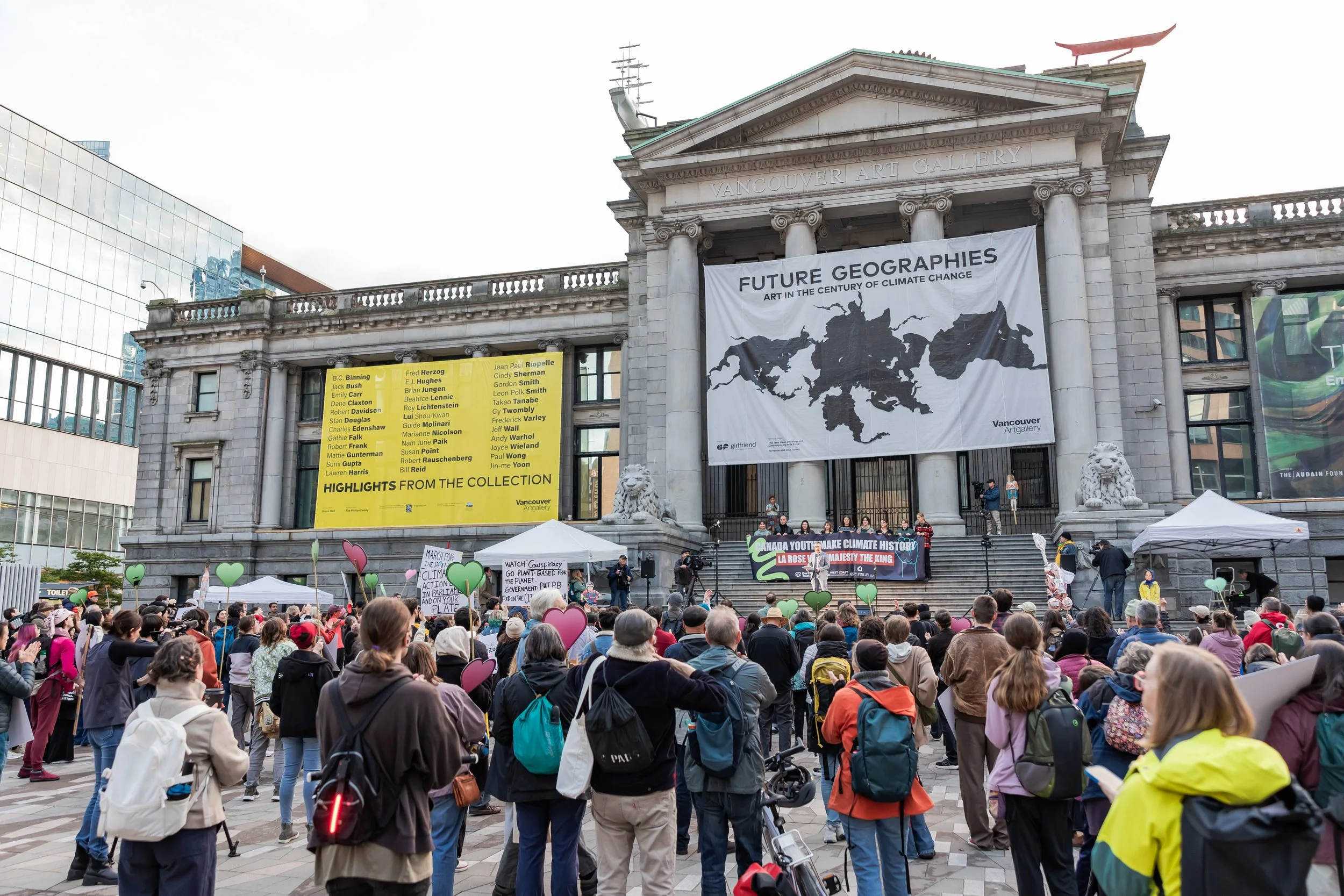
Hundreds filled the steps of the Vancouver Art Gallery on the night the trial began, beneath the banner for its climate exhibition. Photo by Kim Bellavance.
October 28, 2026
They did not walk alone
At 8:30 on Monday morning, under a soft grey Vancouver sky, about 100 people gathered on the sidewalk outside the Federal Court of Canada and waited. There were elders and students, singers from the West Coast Labour Chorus, pink and green paper hearts lifted on sticks above the crowd, and signs that said what everyone there already believed: Youth Over Fossil Fuels. And when the young plaintiffs in La Rose v. His Majesty the King came walking up the street through the fallen autumn leaves, the whole sidewalk rose to meet them with cheers.
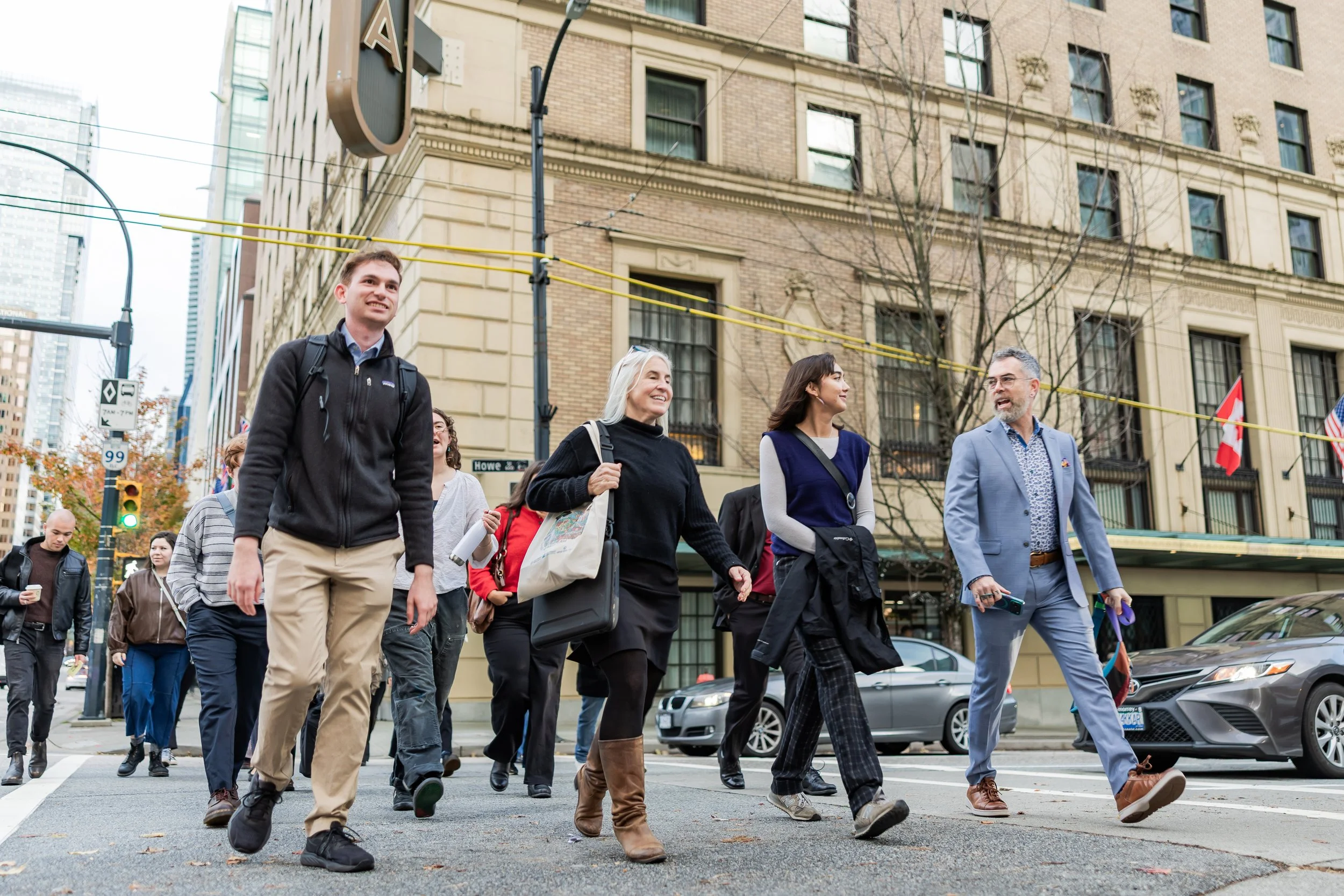
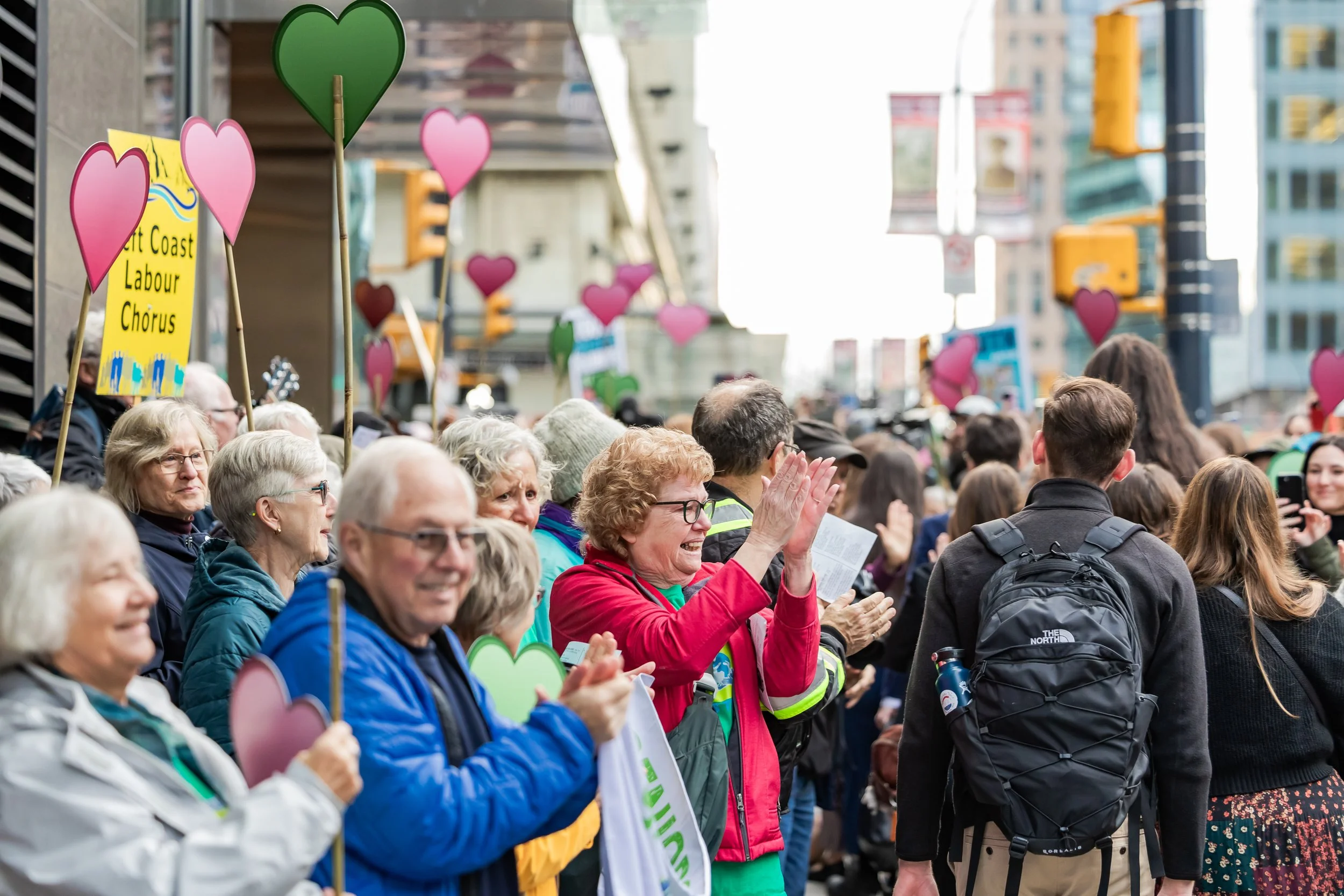
Photos by Kim Bellavance.
For them, it was a kind of homecoming. Seven years and a day earlier, on October 25, 2019, fifteen young people stood on the steps of the Vancouver Art Gallery and told the world they were suing their own government; the youngest among them was just 10 years old. They have grown up inside this case since then, finishing school, moving away for university and work, and, in one case, finishing law school and becoming a mother while she waited for her day in court.
On Monday, they came back together to walk into the first federal youth climate trial in Canadian history. And from that sidewalk in the morning to the gallery steps long after dark, the public walked with them.
Process and percentages, and the silence of burned land
Inside the courtroom, Catherine Boies Parker of Arvay Finlay, an attorney for the youth plaintiffs, rose and named what was at stake: “This case is about the most fundamental interests of children in Canada – their rights to life, liberty and security of the person.”
The plaintiffs carried the court back to 1988, when Prime Minister Brian Mulroney stood before a world climate conference in Toronto and promised that “Canada is committed to taking the necessary action.” None of these young people had been born yet. They have spent their whole lives in the long gap between that promise and what followed, as Canada, in their lawyers’ words, “repeatedly failed to set sufficient targets, repeatedly failed to meet those insufficient targets.”
Canada’s response was the kind that should stop every parent cold. Its lawyers told the court that the Charter places no legal duty on the government to cut emissions to protect young people, and they described Canada’s own climate law as “a procedural statute” that “does not require Canada to achieve the GHG emissions reduction target it sets.” Follow the process, in other words, and no one is responsible for where it leads. As for Canada’s emissions, they said, at about 1.4% of the global total they are simply too small to matter.
The plaintiffs had already answered that, with an image that stays with you: Canada’s emissions matter “significantly when the bucket is already overflowing.” Canada is the world’s 11th-largest emitter and one of its largest producers of oil and gas, and it has admitted both that every tonne of carbon dioxide adds to global warming and that it is not on track to meet its own targets.
What these young people are asking for is not radical. They are not asking a judge to write climate policy; they are asking the court to find that Canada’s targets violate their Charter rights, and to order the government to set a science-based target with a real plan to reach it. Their lawyers put it in words I keep returning to: children’s most basic rights should not depend on “what direction the political wind is blowing at any given time.”
That afternoon, for the first time, the court heard from one of the young people themselves. Kira Young, now 20, grew up in Yellowknife, and in the summer of 2023 she watched wildfire smoke darken the sky over her hometown until the entire city was ordered to leave. “The sky was often black or orange in the middle of the day,” she told the court. “Ash fell from the sky.”
She has since biked through the burned forest outside the city, and she described for the judge what she found there. A living forest, she said, is full of sound, the wind moving through the pines and animals moving among the trees, but “being in an area that’s so recently been burnt is unusually silent.” Standing in that silence, she said, “I feel overwhelmingly sad. Very, very sad and very anxious to think about the future.”
And so the first day of trial came down to two voices: a government talking about process and percentages, and a young woman describing the silence of burned land.
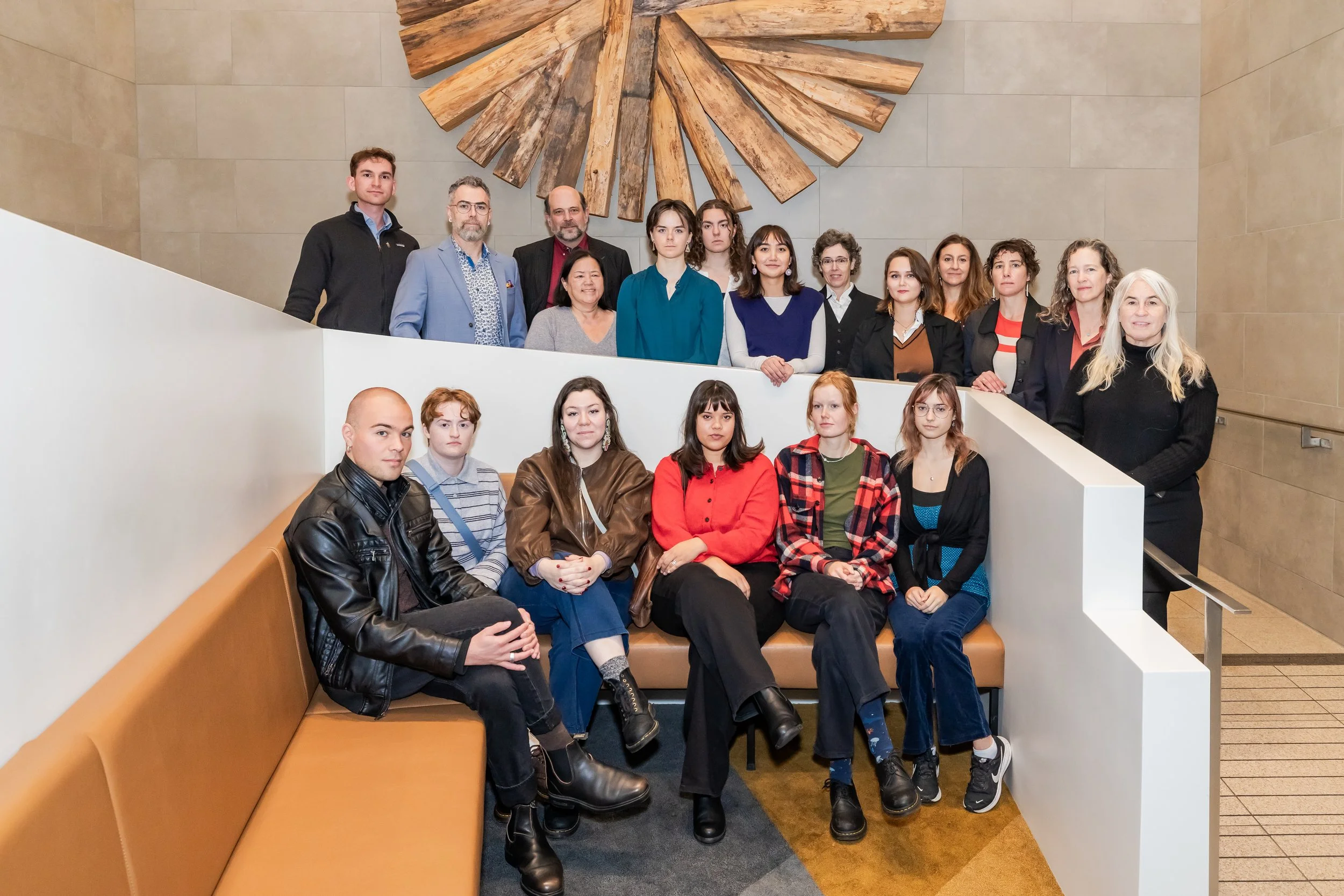
The plaintiffs and their team on Day 1. Photo by Kim Bellavance.
A room full of hope
A courtroom holds only so many people, so a few blocks away, the Vancouver Art Gallery opened a room where anyone could watch the trial live, and more than 50 people came to support, watch, and cheer on the plaintiffs as their case unfolded across the street. When Catherine Boies Parker, attorney from Arvay Finlay, finished the plaintiffs’ opening statement, the room broke into cheers and applause, which is not something you often hear for a legal argument. But these were people who had followed this case for seven years and waited a long time for this day. You could feel the hope in the room.
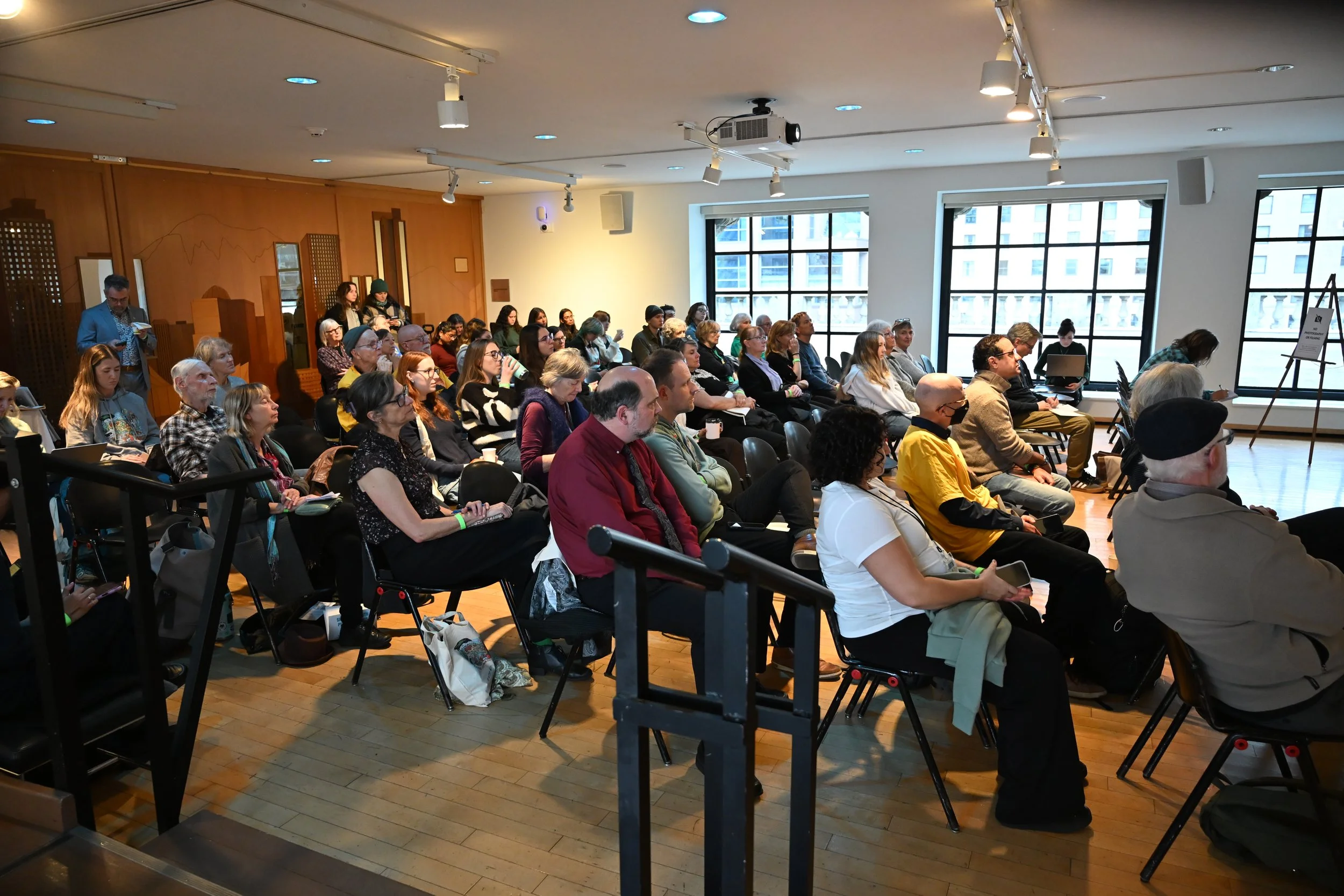
And it was more than a screening. Beyond the rows of chairs, the viewing party had become a gathering in its own right. People shared lunch at long tables and traded stories. Elders in green Seniors for Climate shirts crowded into a photo booth framed by a wall of red roses, laughing as they held up signs that read I Support La Rose! and For Future Generations, while young people posed with cut-outs of judges’ robes. At one table, people sat quietly writing letters. And a long banner reading I Stand With the Youth Plaintiffs in La Rose v. His Majesty the King slowly filled with handwritten messages in every color of marker: Be strong. You got this. I am so proud of you for your courage and determination.
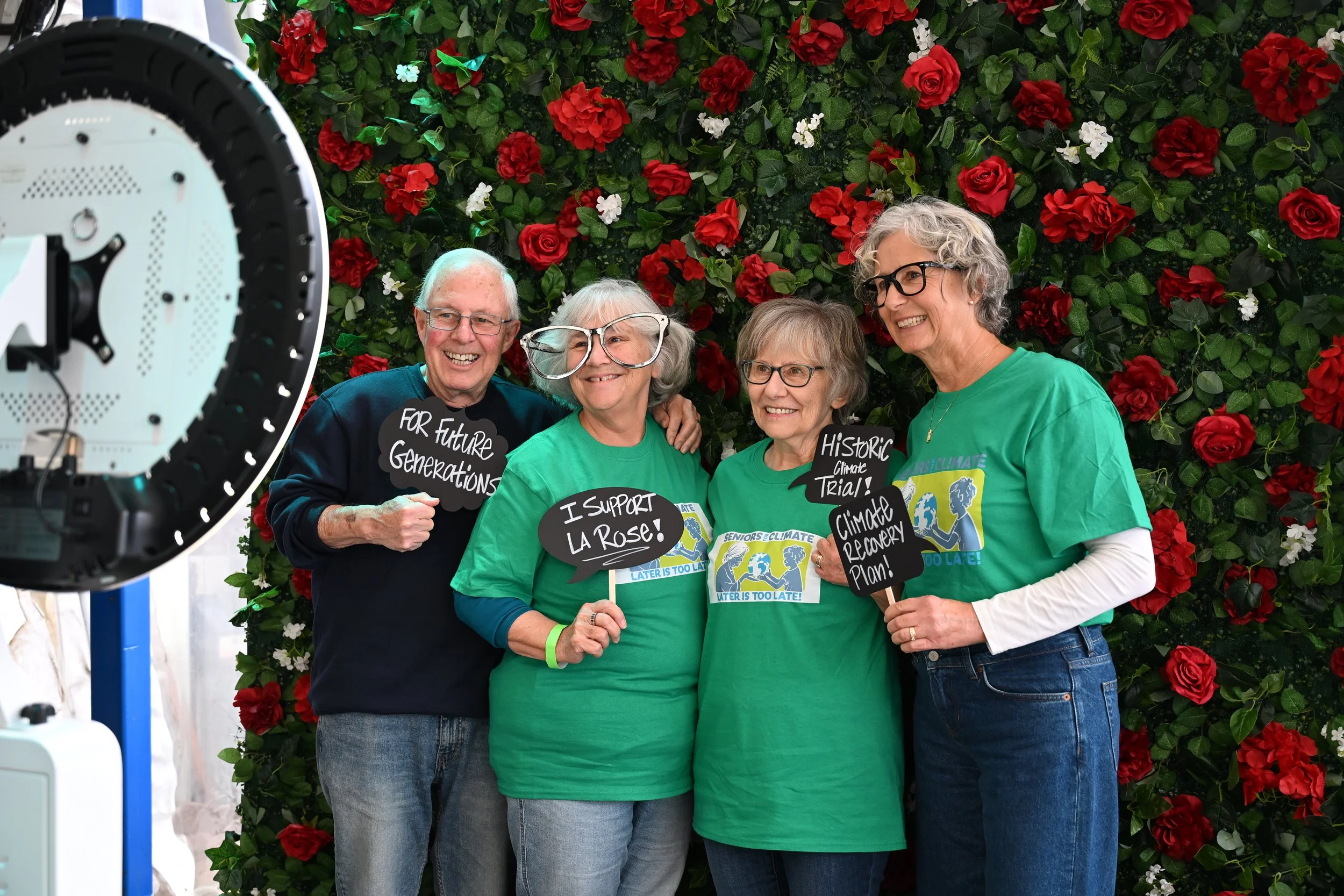
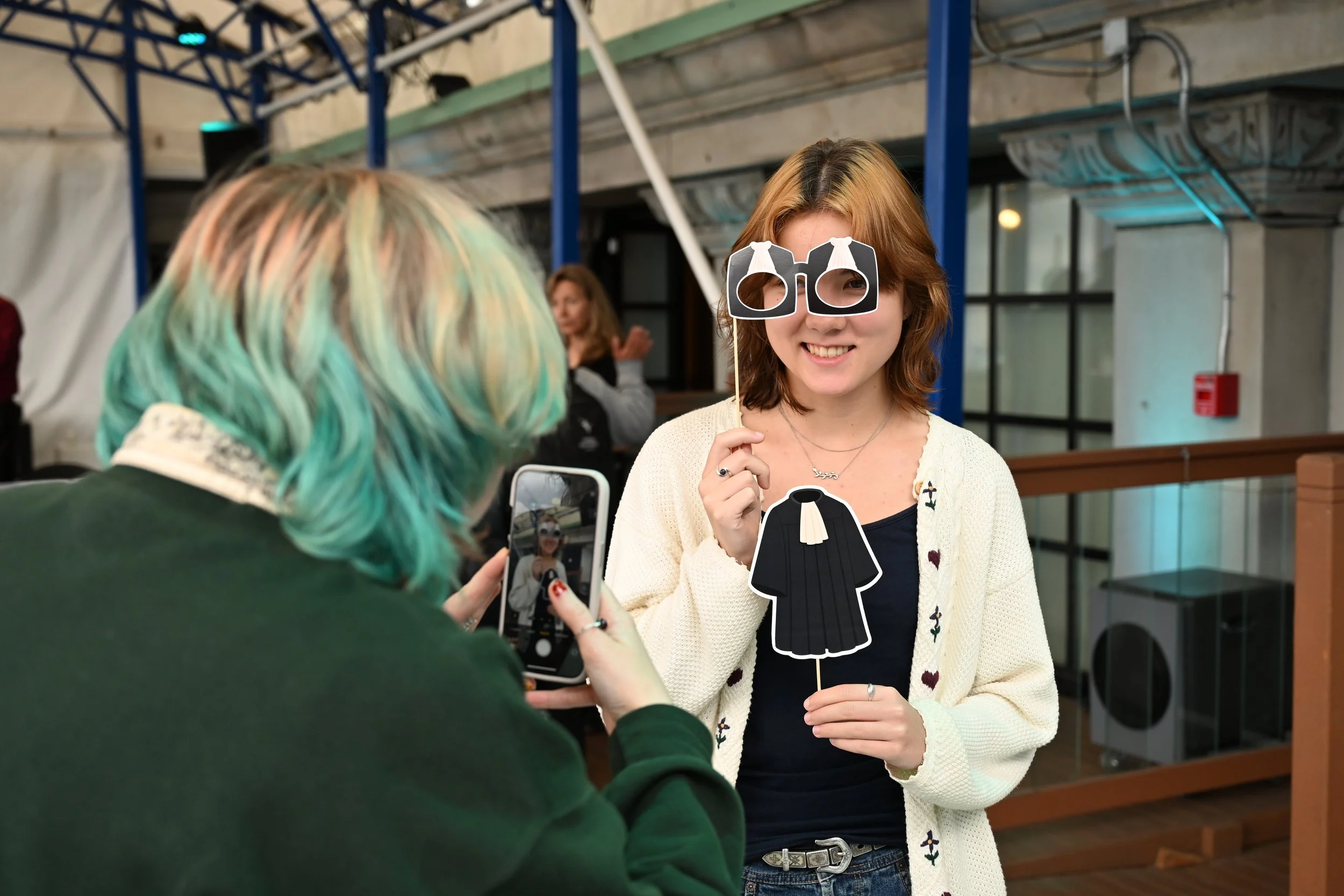
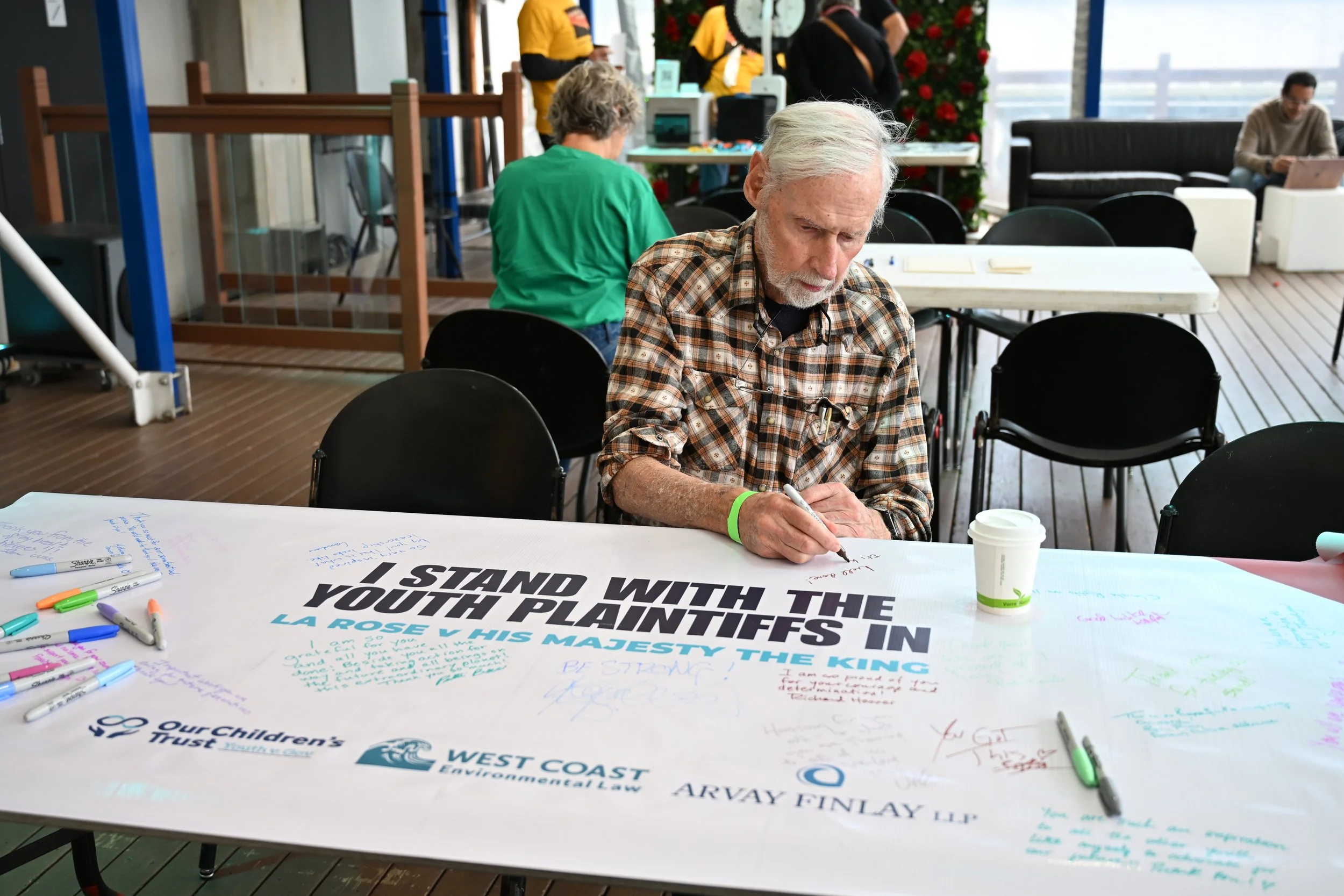
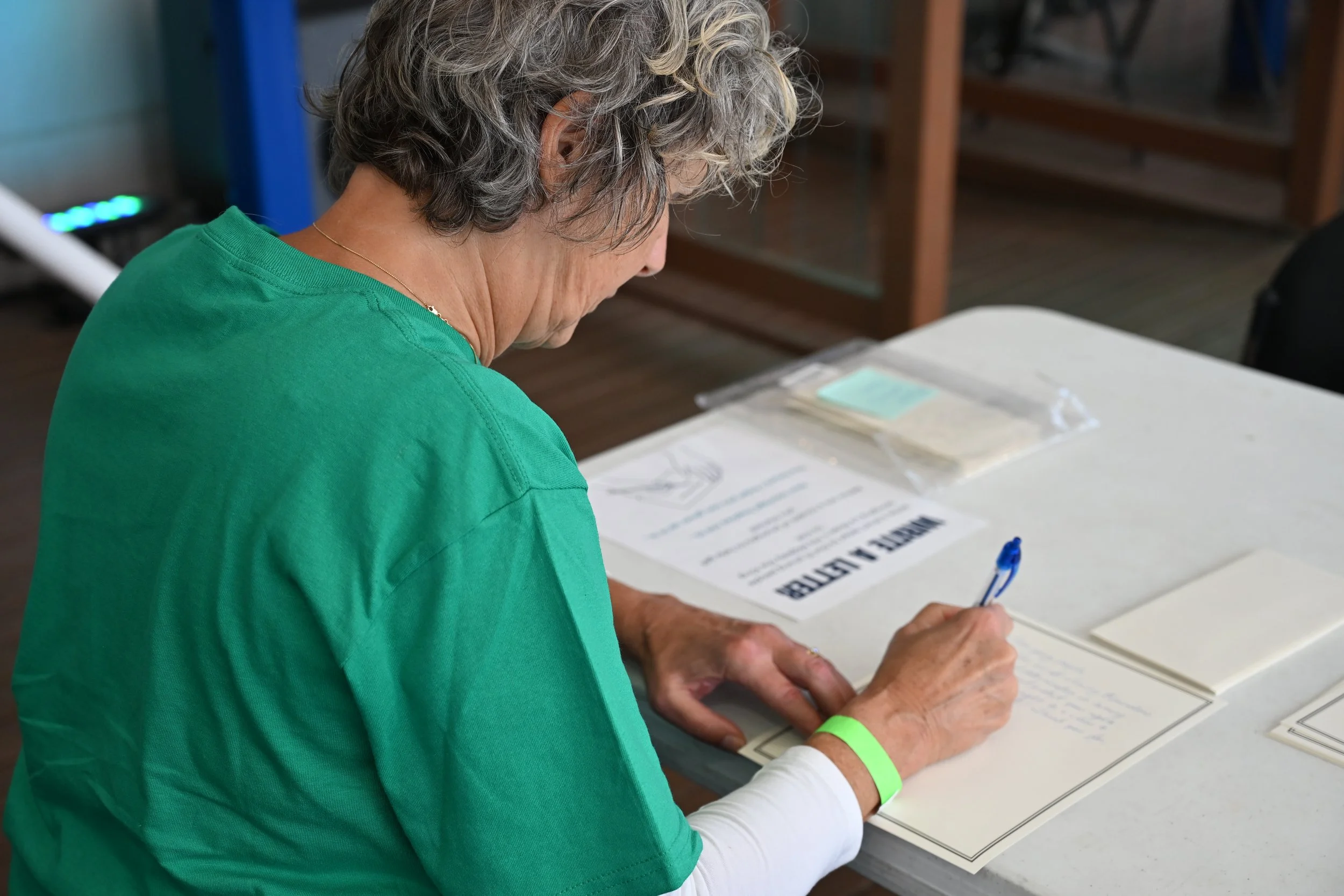
At the viewing party: a photo booth, a banner of messages for the plaintiffs, and plenty of laughter. Photos by Eillin Delapaz-Aceves.
There is something fitting about watching a constitutional case unfold inside an art gallery, since both are places where a society decides what it values and what it hopes to hand down to the next generation. This gallery, as it happens, is currently showing Future Geographies: Art in the Century of Climate Change, “the first major exhibition in Canada to examine the intersection of the climate crisis and contemporary art.” Its more than 35 works, by artists from around the world and from here in B.C., ask what kind of future we are building. On Monday, only a few blocks apart, the artists and the young plaintiffs were asking that same question, one of them to the public and the other to the court.
After dark, hundreds on the steps
By 5:30 that evening, as the light began to fade, hundreds of people had filled the plaza outside the Vancouver Art Gallery for the Youth v. Canada Climate Rally. These were the very steps where the plaintiffs had announced their case seven years before, and this time the great Future Geographies banner hung above them, a map of a changing world stretched between the gallery’s columns.
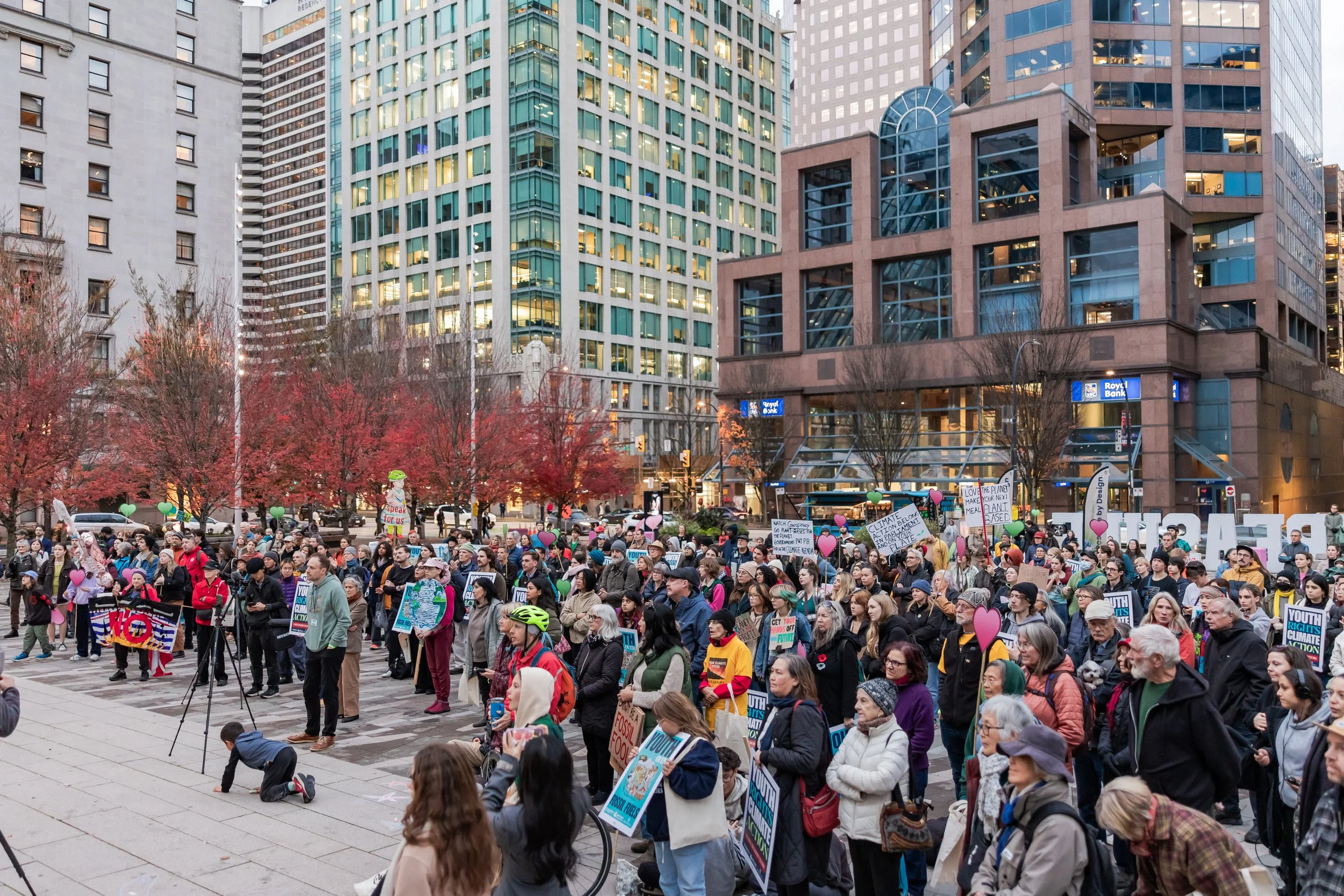
Rhythm Rebellion opened the night, and I had the honor of emceeing as we gathered on the unceded territories of the Musqueam, Squamish and Tsleil-Waututh Nations, who have cared for these lands and waters for millennia and care for them still. Photo by Kim Bellavance.
One by one, the speakers took the steps. Sophia Sidarous, a La Rose plaintiff who is Mi’kmaq from Metepenagiag First Nation, a land defender and water protector, has finished law school and become a mother in the seven years it took this case to reach trial. Sadie Vipond, a plaintiff from Calgary who joined the case when she was 13, stood up once again. She has spent those seven years growing up alongside this case, through junior high, COVID and high school, and she is now halfway through an environmental sciences degree. She told the crowd what hope has come to mean to her: “Hope for me is not a passive acceptance that it will work out. It is a promise to myself, to future generations, to those that cannot speak for themselves that I will believe that our world will get better because we will work to make it better.”
My colleague Andrea Rodgers, who has walked beside these plaintiffs since 2019, shared the microphone with Anna Johnston of West Coast Environmental Law to explain why this trial is making history. Neelam of Fridays for Future Vancouver spoke for the climate strikers who filled these same streets on the day this case was filed and who, seven years later, are still showing up. Bill Darnell, a co-founder of Greenpeace, which was born right here in Vancouver, came with the Seniors Climate Witness Group to stand beside the young, and Julius Frauenheim of UBC’s Environmental Policy Association led chants he promised would carry all the way to the courthouse. And through it all, Luke Wallace’s songs wove the evening together.
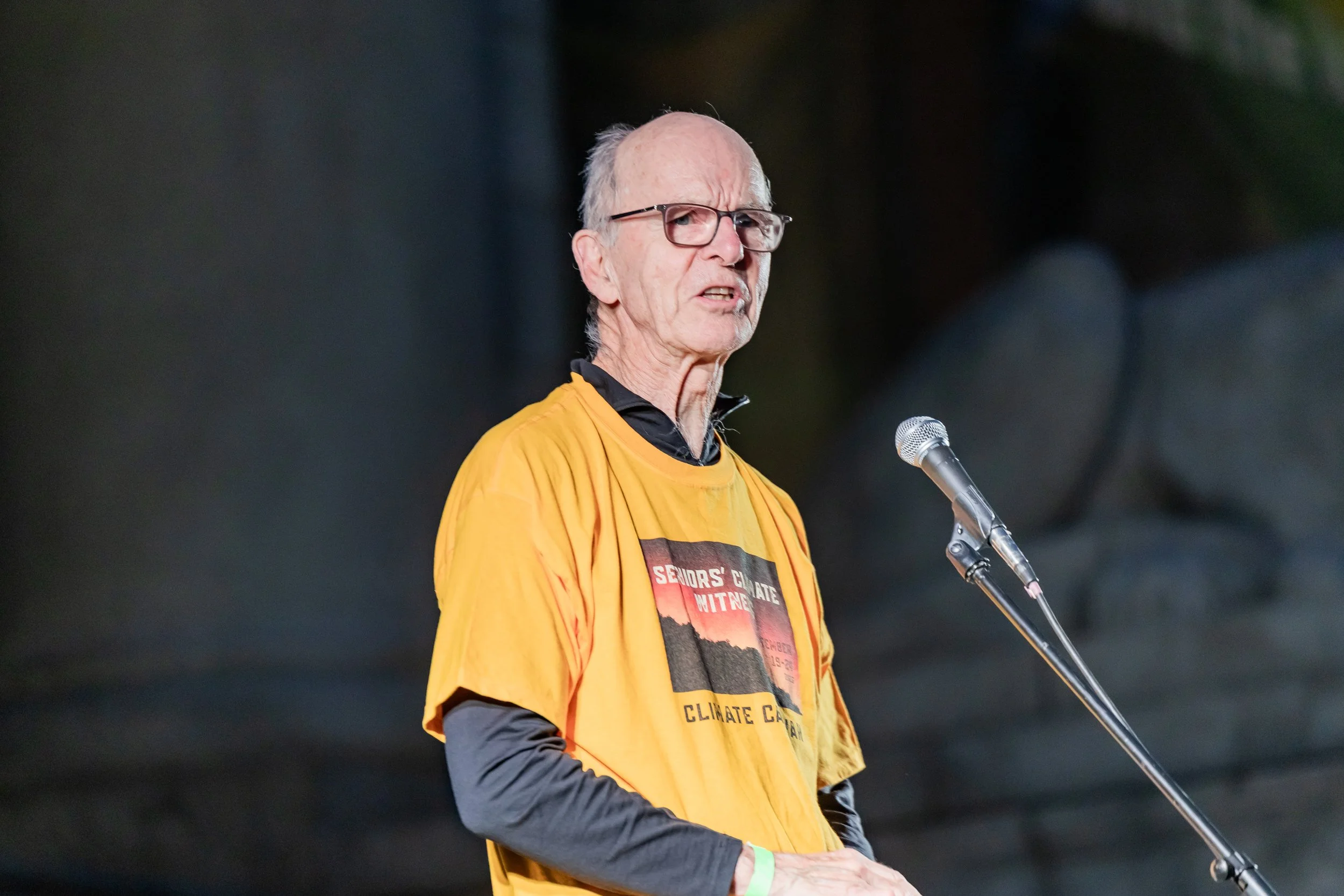
Greenpeace co-founder Bill Darnell, speaking for the Seniors Climate Witness Group.
This is how culture changes
Look at who stood together on Monday: a Greenpeace co-founder beside students who weren’t yet born when he started; a Mi’kmaq land defender who became a mother while her case waited for trial; climate strikers who were children when this case was filed and are grown now, still marching; union singers, a coalition of 30 partner organizations, and Our Children’s Trust and West Coast Environmental Law, side by side.
And look at where they stood: in a federal courtroom where the law was argued, in an art gallery with a climate exhibition on its walls, and out on the gallery steps, where there was music and there were speeches, where hand-painted figures of children held up signs asking the court to “speak for us,” and where someone had chalked drawings of the Earth onto the plaza beside two words in looping letters: youth forever!!
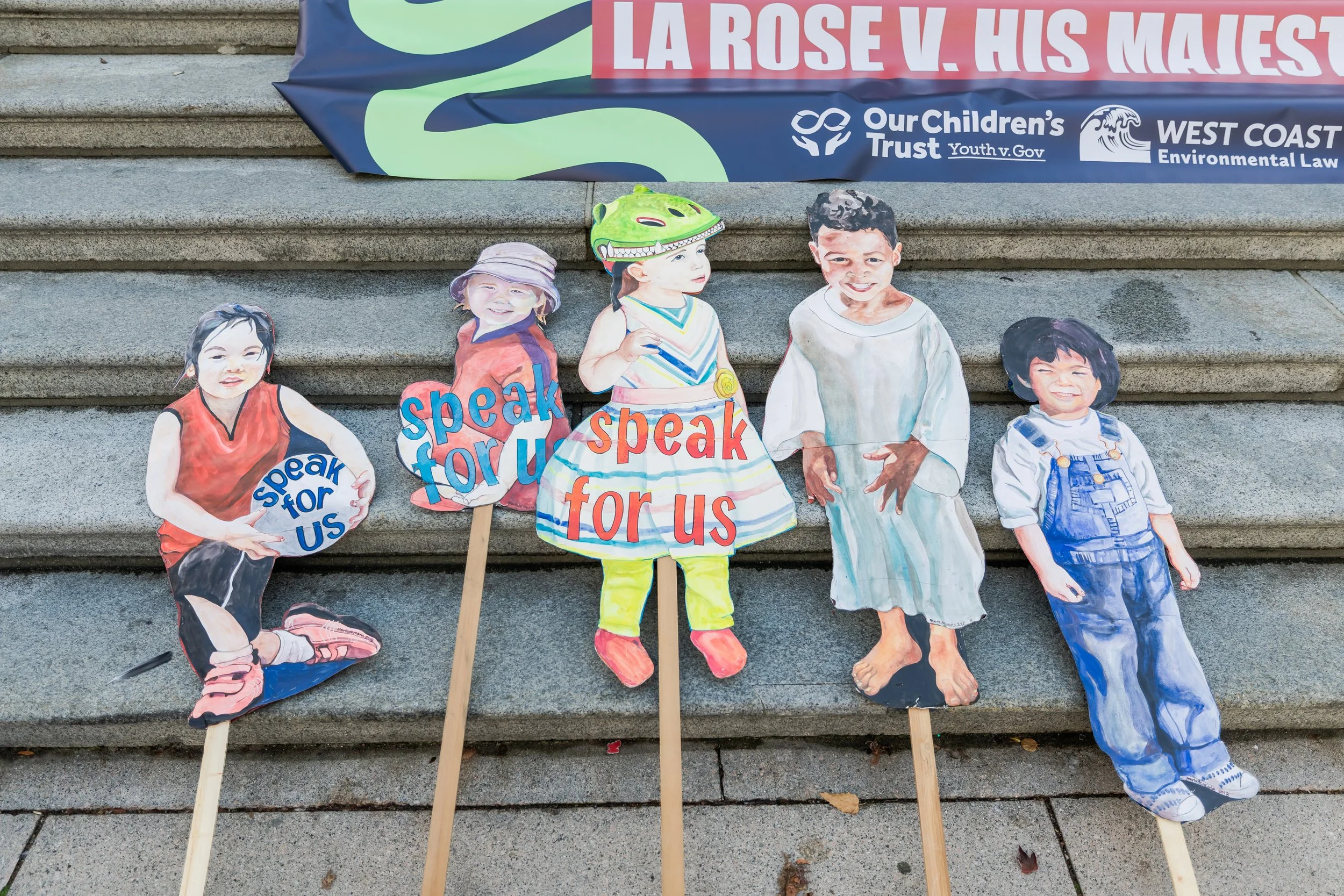
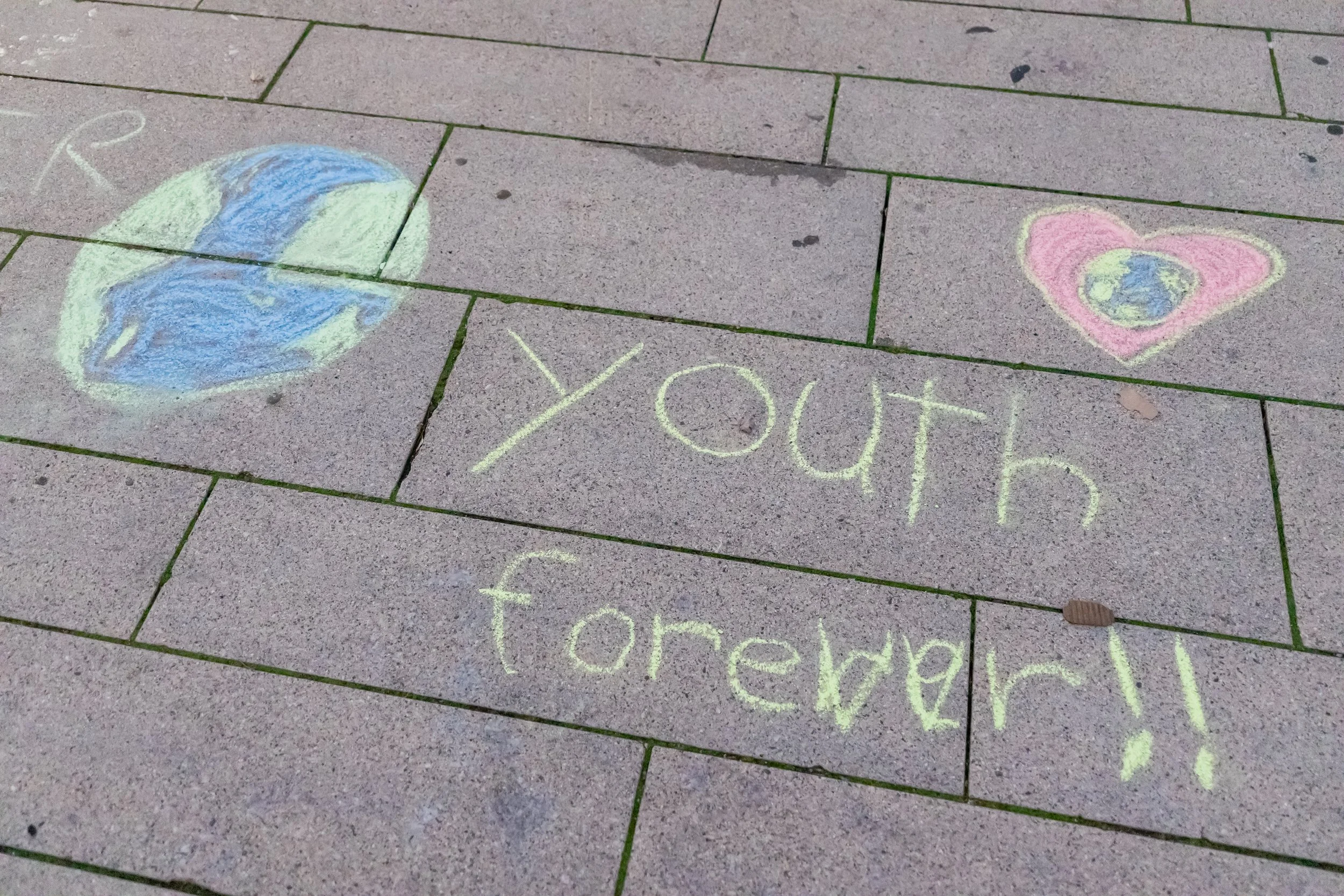
Photos by Kim Bellavance.
None of this is decoration. Courts decide cases, but they decide them inside a culture. What we believe children are owed, what we believe a government must do, and what we will no longer tolerate are all shaped in rooms like that gallery and in the streets, by people who show up together. When you bring organizations and generations, law and art into the same space, you begin to change what a society believes is possible. A ruling can recognize a right, but it is culture that makes the right real.
That culture begins with how we care for the young people at its center. They are rights-holders, not symbols, and climbing onto a witness stand to relive the disasters that shaped your childhood is a heavy thing to ask of anyone. So throughout the trial, from morning until night, we surround them with support. They have a gathering space that is theirs alone, stocked with snacks and, more importantly, with each other. Every morning begins with a dance, an Our Children’s Trust tradition, and every day we come back together to debrief over lunch and again over dinner.
This is the heart of our trauma-informed approach: building real relationships with these young people, and helping them build relationships with one another, at every step of the way. A movement that asks young people to lead has to care for them while they do.
Your turn
Our work has taught us that a win in court is never the finish line. Rights are won by people who show up, and they are kept by people who keep showing up long after the cameras leave. Securing these rights takes a public that is watching, and keeping them takes a public that stays.
That public is you. Testimony continues through November 20, and wherever you are, you can be part of it:
Watch the trial. It is open to the public by Zoom webinar. Register through the Trial Headquarters page.
Sign the Wall of Support and tell these young people you are with them.
Amplify their voices. Use the trial toolkit and tag @youthvgov and @wcelaw.
Stay with us. Join our mailing list for updates from the courtroom as the trial unfolds and donate what you can.
Seven years ago, fifteen young people stood on the steps of the Vancouver Art Gallery and asked a court to hear them. On Monday night, hundreds of us stood on those same steps and gave them our answer: we hear you, and we are not going anywhere.
Sadie ended her speech with a message to the 13-year-old girl who first joined this case, and I can’t think of a better way to end this one:
“The path is going to be long and it’s not going to be easy. But you will learn so much and meet so many amazing people and you will keep going despite the challenges. You will not lose sight of what is good, and maybe, just maybe, your community will be able to change our country for the better.”
And by everything in all of us – we are going to try.
Stand with Sadie and the rest of the Canadian youth plaintiffs wherever you are. Join us. Be a part of this history.