
Small Steps to an Ultimate Victory: A Reflection on Genesis v. EPA
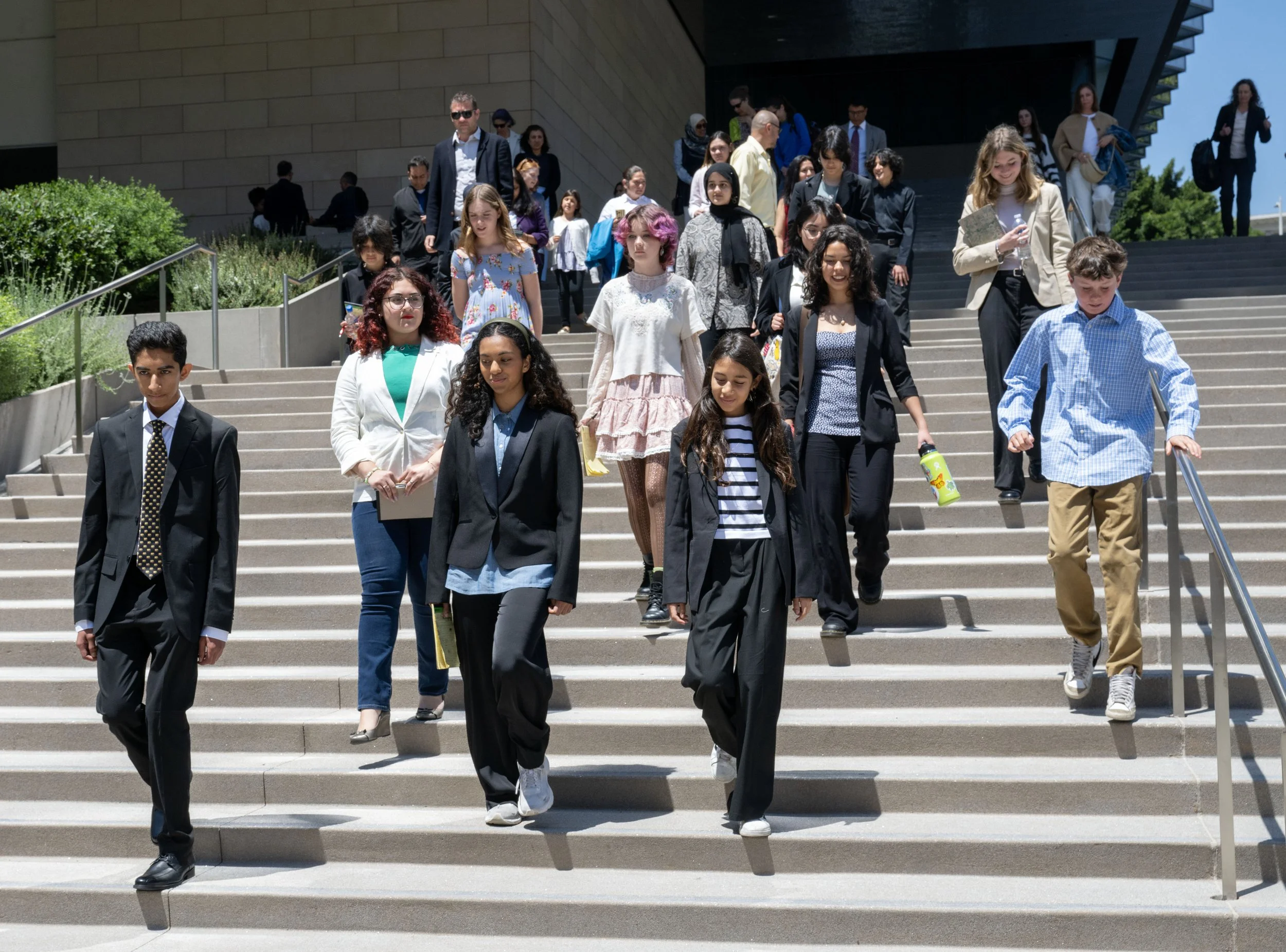
Genesis v. EPA youth plaintiffs at a court hearing in Los Angeles. Photo by Robin Loznak.
August 27, 2026
By Emma Weibel
I was 16 years old when I sued the federal government for the first time. As a plaintiff in Genesis v. US Environmental Protection Agency (EPA), I joined 17 other young Californians in 2023 to challenge our government’s role in intentionally allowing life-threatening levels of fossil fuel climate pollution and discriminating against us as children by discounting the value of our lives and future when deciding how much pollution to allow, violating our constitutional rights. Our case joined a relatively small (but ever-growing) collection of other cases, many of which were also brought forward by Our Children’s Trust, focused on the fundamental rights of young people in the face of the climate crisis.
Earlier this year, after a long process of court hearings and appeals, and without us ever getting the chance to argue the case on its merits, Genesis v. EPA was dismissed. The court wasn’t prepared to let us in the courthouse doors so we could prove that climate change is the direct result of concrete governmental action around what it values and what it doesn’t. Our government says out loud, over and over, that it values the profits of fossil fuel activities more than it values children’s lives, health, and safety. Our judges did not grasp the gross injustice at hand: the systematic devaluing of the lives of young people and the deprivation of the promise of life, liberty, and the pursuit of happiness from an entire class of citizens.
Having our case dismissed was heartbreaking, to say the least. At that moment, it was easy to feel like it was all futile. Why should we attempt to reason with courts—and governments—that refuse to recognize our most fundamental rights? The frustration that my co-plaintiffs and I felt was immense and difficult to reconcile with my own stubborn hope that the arc of the moral universe does eventually bend toward justice.

Emma Weibel. Photo by Robin Loznak.
Three years have passed since we first filed this case, and while that may not seem like much, it represents the difference between my high school junior self, who had no idea what she wanted to do with her life, and who I am today: an incoming second-year university student pursuing environmental and human rights law. In this time, I have gained more tools and insight to understand that our case was part of something much bigger than just us. Win or lose, it is a piece of the still-incomplete puzzle of the more just future we are fighting for. If there’s one thing we can all learn from our nation’s history, it is that these kinds of fights aren’t won overnight.
The earliest reported court case on public school desegregation (Roberts v. City of Boston) dated back to 1849, more than a century before Brown v. Board of Education. As one can imagine, the 1849 ruling affirmed racial segregation in schools, and so did a plethora of other rulings between that first case and the landmark decision in Brown.
While we like to think of our legal system as a fixed and impartial entity, it exists within the context of ever-evolving social and political moments. Thus, cases are not just about winning in front of one judge, but also about starting a conversation and educating the legal community, as well as the wider populace. In fact, the arguments in Genesis have already inspired new conversations and actions outside the legal sphere. But I believe this case will also make an impact in ways that are not as apparent from where we currently stand.
One helpful framework to understand the (often long-winded) process driving meaningful social and policy change is University of Michigan Professor John Kingdon's Multiple Streams Framework. Kingdon argues that policy change depends on the convergence of three independent but interconnected streams.
The first is the problem stream, which reflects how the public, policymakers, and experts come to recognize an issue as a problem that requires action and assign responsibility for it. The second is the policy stream, which consists of the range of potential solutions developed and promoted by researchers, advocates, and policymakers. The third is the politics stream, which encompasses the broader political environment, including public opinion, changes in government leadership, the priorities of elected officials, and the influence of interest groups.
According to the framework, major policy change becomes possible when these three streams align, creating a policy window, a brief opportunity during which a recognized problem, a viable solution, and a favorable political climate come together to enable substantial and often rapid change.
I find this framework to fit exceedingly well for the issue of climate change, where it seems like we are stuck in a constant battle to make people care, pitch solutions, and harness the political will to make those solutions a reality. Victory in such a sprawling social justice movement will necessarily be the result of many small steps, both wins and losses, that shift the streams closer to the moment of alignment. We can (and should) still be enraged by all the injustices that continue to be perpetrated in the meantime, but we cannot let a denial of justice turn us away from the cause. We must honor those harmed by continuing to fight.
We do not have a century to stop the harmful impacts of the climate crisis. As the world barrels toward more irreversible climate damages, we need all hands on deck to sail every stream of change, even if the immediate impact of each action isn’t always apparent. Our Children’s Trust’s continued commitment to protecting children’s rights in the courtroom is an important piece of the puzzle, one that I will be eternally grateful to be a part of. Since the end of Genesis, I have joined two other cases with OCT (as a petitioner in Venner v. EPA to reinstate EPA’s Endangerment Finding and federal greenhouse gas emission standards for vehicles and as lead intervenor in United States v. California Air Resources Board (CARB) to defend my State’s ability to also stop pollution from vehicles and support EVs). I am excited and empowered to continue to do this work in the third branch of our government, where I believe young people will finally be recognized as equal rights-holders deserving of life, liberty, and the pursuit of happiness in a world not ravaged by fossil fuels and climate change.
As I move into these new cases and into my own career, I know that the experiences I had as part of Genesis v. EPA will continue to guide me in my journey. While there are so many forces that seek to dampen it, through my co-plaintiffs, our legal team, our families, and our supporters, my fierce hope for a better future burns ever-bright.