

Youth Provide New Hope to Protect the California Air Resources Board’s Legacy
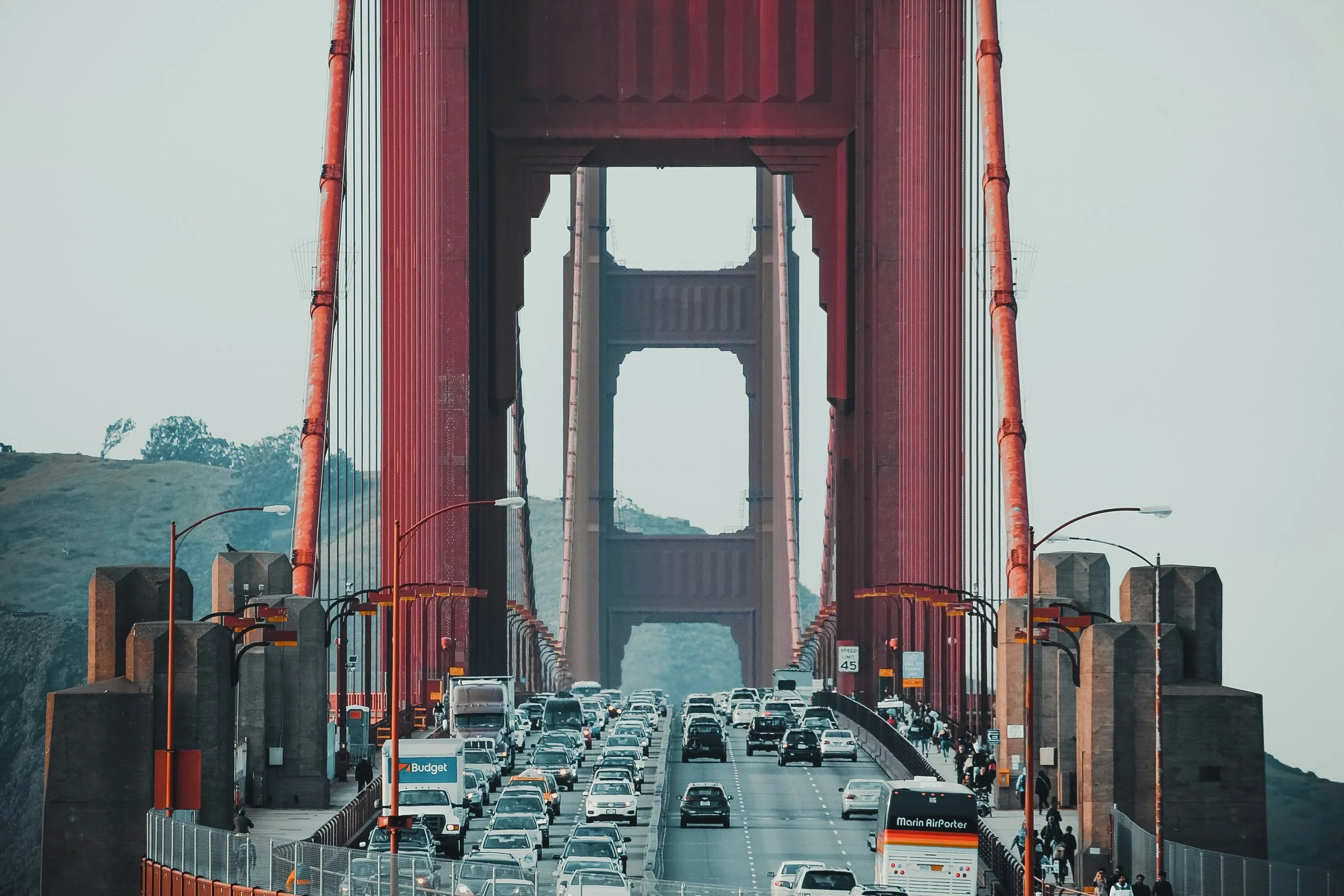
Traffic on the Golden Gate Bridge in San Francisco, California. Photo by Saketh.
August 27, 2026
California’s Long History Regulating Tailpipe Emissions to Protect Health and Welfare
At the close of the summer of love on August 30, 1967, California Governor Ronald Reagan approved and signed the Mulford-Carrell Act that created California Air Resources Board or “CARB.” The next year, Reagan’s CARB was provided its first waiver from the newly minted federal Clean Air Act for California to set its own vehicle emission standards. The goal of these Reagan-led actions? CARB was to protect the public’s health from toxic air pollution. Reagan’s CARB also had the goal of promoting and inspiring novel means of cutting air pollution.
The Clean Air Act was designed as a “technology-forcing” law to push towards elimination of air pollution that harms human health and welfare. Importantly, the federal Clean Air Act recognizes “that air pollution prevention (that is, the reduction or elimination, through any measures, of the amount of pollutants produced or created at the source) and air pollution control at its source is the primary responsibility of States and local governments.” 42 U.S.C. § 7401(a)(3). The primary role of the federal government was to provide “financial assistance and leadership essential for the development of cooperative Federal, State, regional, and local programs to prevent and control air pollution.” 42 U.S.C. § 7401(a)(4).
Let’s focus on what CARB is best known for: vehicle emission standards. In the 1970s and with the power that Reagan secured for CARB, California first began to regulate the harmful nitrogen oxides that came from tailpipes. CARB’s actions brought the two-way catalytic converter to the public, followed by limits on lead in gasoline, so the device could work properly in cleaning up engine exhaust.
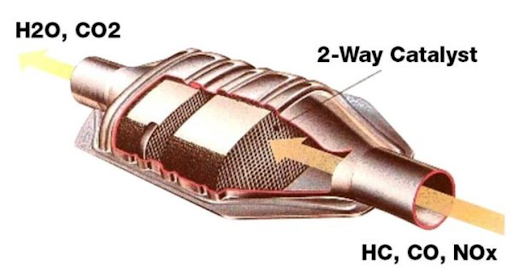
While those regulations were designed to limit, and eventually eliminate, deadly fossil fuel pollution, CARB also recognized that greenhouse gases were a form of pollution (see the carbon dioxide still coming out the catalytic converter above). Indeed, transportation has been the largest source of California’s fossil carbon dioxide emissions for as far back as data goes. Since 1981, more than half of California’s carbon dioxide emissions have come from transportation. Accordingly, CARB knows that if California is going to tackle its greenhouse gas emission, it is going to have to address transportation carbon dioxide emissions.
In 1990, California’s Republican Governor George Deukmejian established California’s zero-emission vehicle mandate, requiring a percentage of car sales in California be zero-emissions. This was the first regulation of its type in the world. Then in 2004, under Republican Governor Arnold Schwarzenegger, CARB adopted the first rule in the United States requiring vehicles to reduce greenhouse gas emissions. In 2009, under the ‘Governator,’ CARB set new zero-emission goals for 2012. In 2011, with Arnold still at the helm of California, CARB and the U.S. Environmental Protection Agency and Department of Transportation aligned light-duty vehicle greenhouse gas emission standards to fulfill the Clean Air Act’s intent for state and federal governments to cooperate to prevent air pollution to most effectively protect public health and welfare.
After 2012, CARB has been the leading agency for pushing reductions in vehicle greenhouse gases emissions and adoption of zero-emission vehicles, which have guided and inspired nationwide goals, including aligning national vehicle standards to CARB’s. Again leading the way, California set its most recent standards update to the goal of 100% zero-emission vehicle sales by 2035. As of my typing here, CARB has enabled the sale of 2.7 million zero-emissions vehicles with 137 available models and the installation of 216,523 zero-emissions fueling stations.
Zero-emissions vehicles, most commonly electric vehicles (EVs), have many economic benefits in addition to not emitting carbon dioxide from the tailpipe. According to the U.S. Department of Energy, EVs improve overall fuel economy, lower driving/fuel costs, and improve air quality. In particular, the DOE states: “Using electricity as a power source for transportation improves public health and the environment, and provides safety benefits, and contributes to a secure transportation system.” Concerns over the embedded greenhouse gas emissions in EV production are overblown. Replacing an almost new internal combustion engine (ICE) vehicle with a new EV negates the EV’s production emissions within a driving distance of 4,400 miles for a car or SUV and 6,700 miles for a truck. That’s just 4 to 6 months of traditional driving!
The “Trickle-Down” Success of CARB's Vehicle Emission Limits
Let’s now look at carbon dioxide emissions. California’s transportation carbon dioxide emissions have fallen from their high in 2007. In tandem, California’s overall fossil carbon dioxide emissions have fallen from that 2007 high, with 63% of this reduction due to the cleaning up of transportation. In fact, California is one of only nine states that have reduced their transportation emissions back below 1990 levels. California’s 2024 emissions were 10.6% below its 1990 emissions, second only to New Jersey’s 21.1% reduction. But we should consider context. California is the world’s fourth-largest economy, only behind the rest of the United States, China, and Germany. We don’t hear New Jersey’s economy mentioned in the same breath with these other three countries.
How have those other three world-leading economies’ transportation carbon dioxide emissions fared since 1990? Well, the U.S. (less California) increased its transportation emissions by 21.8% relative to 1990. China increased its transportation emissions by 1000% since 1990, but note that in 1990 China was a much different country than the global leader in zero-emission vehicles it is today. Germany’s 2024 transportation emissions were 12% lower than their 1990 emissions, similar to California. Germany also has overall strong policies for reducing greenhouse gas emissions, like California. Germany and California’s policies and actions are aligned with limiting global warming to two degrees Celsius or less while the U.S.’s policies are aligned with four degrees Celsius of global warming. As an aside, China’s policies and actions are aligned with a three degrees Celsius future, and therefore better than the U.S. and illustrating the fallacy of that “what about China” argument for not reducing emissions in the U.S.
This path towards clean transportation and the attendant clean air that Reagan initiated is ironically akin to one of his less successful policies: CARB’s regulations have trickled down to drive the growth of cleaner, lower-emitting vehicles. In 1990, President George H.W. Bush signed Clean Air Act Amendments, which allowed other states to adopt CARB’s standards. Notably, six of the nine states that have reduced their transportation emissions below 1990 levels adopted CARB’s standards, including the aforementioned New Jersey. To date, a total of 17 states and D.C. have adopted CARB’s vehicle emission standards. When compared to the other 33 states that have not followed CARB’s lead, the CARB-aligned states have seen their average transportation carbon dioxide emissions increase by 8.0% relative to 1990 while the other 33 states have seen an average 33.3% increase. It is clear that CARB's regulations are slowing emissions growth, but not yet getting to zero emissions, which is what is needed to stop global warming.
In hindsight, CARB worked exactly as was intended when Governor Reagen brought it into existence: clean up the air and drive innovation with an attendant trickle-down impact where CARB-aligned states have lower-emitting transportation sectors than in the absence of CARB’s leadership. CARB’s impacts have occurred under Republican and Democratic leadership at the California and federal level. This is a bipartisan win for all Americans with cleaner air and a lower level of global warming than would have otherwise occurred. The auto industry has overall supported CARB’s regulations, with periodic push-back and grumblings like teenagers being forced to go on a hike but ultimately loving the adventure, because the rules allow them to make vehicles that will meet the regulations of other nations, regulations that were themselves inspired by CARB.
I hope you appreciate the far-reaching impact that CARB has had on our nation and other nations. This undermines another common argument for not addressing climate change: “our local/state/country emissions are small compared to others so our actions on this won’t matter.” Just like fashion trends, governments copy and inspire each other. This is particularly true when the change brings economic innovation and growth along with it.
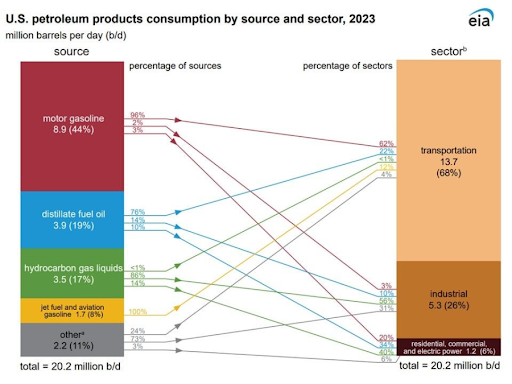
Given this bipartisan success, why are we in this mess? There is one industry dead set against CARB and its trickle-down effect on reducing tailpipe emissions: oil. The majority of oil in the U.S. is used as gasoline and diesel to move cars and trucks (see bar chart). CARB’s zero-emission vehicle mandate directly threatens the entire U.S. oil industry. Without cars and trucks perpetually consuming non-renewable gasoline and diesel, there is no need to constantly mine and refine oil to liquid fuels. The tipping point for oil industry collapse is closer than people think. Oil refineries are only profitable down to 65-70% capacity. If demand falls below this threshold, the refinery is no longer financially viable. Refineries are already closing in parts of California because the zero-emission vehicle mandate has been so successful in getting EVs on the road that fuel demand has fallen below that threshold. The oil industry knows it can’t survive if more zero-emission vehicles come to market. Instead of pivoting their business plans towards the clean mobility of the future, they are doubling down on the days of old.
Which brings us to the Trump Administration. To protect the oil industry at the expense of the American people, the federal government is trying to revoke CARB’s waiver for setting its own vehicle emissions standards, including the zero-emission vehicle mandate. Ignoring the express language and intent of the Clean Air Act, the Trump Administration claims that only the federal government should regulate vehicle emissions. But the Trump Administration has also moved to repeal the Environmental Protection Agency’s endangerment finding, attempting to end federal vehicle emissions regulations, as well as many other regulations designed to limit air pollution. Never mind that this will make American fossil fuel-polluting vehicles unacceptable to the ever-growing global market.
That growing global market is absolutely booming with EVs. The International Energy Agency’s 2026 Global EV Outlook found that EV sales grew 20% in 2025, with every fourth car sold in the world being electric. European sales increased 30%, with 28% of sales being EVs. In China, 55% of all cars sold were EVs, while 97% of all cars sold in Norway were EVs. Note that Norway is “cold,” and this shows concern about battery performance in cold environments is just another whataboutism. In fact, over 100 countries recorded EV sales growth, with places like Brazil and Mexico having 75% sales growth. By 2035 and with no new policies, just what’s going on now, EV sales are projected to increase 6-fold with about half of all cars sold globally being electric. Now that is truly an “electric” market!
The current fleet of global EVs stops the use of 1.7 million barrels of oil a day. This rocketing EV growth is projected to stop the use of 9 to 10 million barrels of oil a day by 2035 based on current policies. If countries follow through on their commitments made by signing the 2015 Paris Agreement, EVs will stop the use of 15 million barrels of oil a day in 2035.
That’s how dangerous CARB’s regulations and global leading goals of 100% zero-emission vehicle sales by 2035 are to the oil industry. Not only is it tipping the oil industry in California towards collapse, but these regulations are also crucial for states to protect their citizens from air pollution. Remember the old adage: “as California goes, so goes the nation.” For instance, Hawai‘i has a constitutional mandate of zero carbon dioxide emissions from transportation by 2045, enforceable through the OCT-led case Navahine v. HDOT that was settled in 2024. Hawai‘i needs CARB’s zero-emission vehicle mandate to ensure an adequate supply of EVs to achieve this goal. The country’s ability to fight climate change thus depends on California. That is why California is fighting back. And that is why these youth filed their motion to intervene as defendants, alongside CARB, in United States v. CARB.
For those Star Wars fans, an analogy may be helpful. It’s nearing the end of Star Wars: A New Hope, a movie Ronald Reagan loved. The Death Star (i.e., the U.S. oil industry) has already destroyed the planet of Alderaan (i.e., the ~12,000 Americans dying each year solely due to U.S. fossil-fuel-emission-charged fire smoke and the ~90,000 Americans dying each year from fossil fuel particulate pollution) and is focusing its sites on wiping out the Rebel Alliance (i.e., the majority of Americans who prioritize renewable energy over fossil fuels). But there is a weakness in the Death Star: that exhaust port leading directly to the main reactor (i.e., oil industry need for gasoline and diesel vehicles to drive >65% refinery capacity or the system fails). Luke Skywalker (i.e., CARB) is locking his proton torpedoes (i.e., zero-emission vehicle mandate) on the exhaust port when Darth Vader (i.e., the Trump Administration) swoops in to take out Luke with Vader’s twin laser cannons (i.e., repealing the Endangerment Finding and revoking CARB’s waiver). Right now, Han Solo (i.e., youth defendants) are diving in and joining the fight with the Millennium Falcon (i.e., constitutional rights to life, liberty, etc.) to knock Darth Vader off course and let Luke complete his mission.
We are right now at that climactic moment of the movie, but this is our reality, our children’s lives, and all of our future. We don’t get to leave the theater after the film ends. We are literally on the planet the Death Star is seeking to destroy. We need Han Solo to fly the Millennium Falcon flawlessly and then say that iconic line to Luke: “You’re all clear, kid, now let’s blow this thing and go home!”